W1-W3. Введение в математический анализ, теория множеств, вещественные числа, математическая индукция
1. Краткое содержание
1.1 Что такое математический анализ?
Mathematical analysis (математический анализ) — это теоретический фундамент, на котором стоит calculus (классический курс «математического анализа» в прикладном смысле). Если calculus учит как пользоваться приёмами и формулами, то анализ объясняет почему они работают: он даёт строгое обоснование понятиям, которые вы могли видеть в школьной математике, — limits (пределы), derivatives (производные), integrals (интегралы).
Главное отличие — уровень строгости. В calculus вы запоминаете правила — chain rule, L’Hôpital’s rule, integration by parts — и применяете их к задачам, но не всегда понимаете, при каких условиях они верны и где ломаются. Real analysis (вещественный анализ) заполняет этот пробел: формальные доказательства и структура вещественных чисел и функций.
В вещественном анализе мы задаёмся базовыми вопросами:
- Что такое real number (вещественное число) в точности? Существует ли «наибольшее» вещественное? Какое число идёт «сразу после» \(0\)?
- Почему у \(2\) есть квадратный корень, а у \(-2\) — нет (в \(\mathbb{R}\))?
- Если и вещественных, и рациональных чисел бесконечно много, почему вещественных «больше», чем рациональных?
- Как брать limit последовательности? Какие последовательности converge (сходятся), а какие diverge (расходятся)?
- Можно ли сложить бесконечно много слагаемых и получить конечную сумму?
- Что значит, что функция continuous (непрерывна), differentiable (дифференцируема) или integrable (интегрируема)?
1.2 Зачем изучать математический анализ?
Понимание анализа важно, если вы хотите пользоваться математикой строго. Правила calculus можно применять «по памяти», но тогда легко ошибиться там, где условия теорем не выполняются. Анализ показывает limits of applicability (границы применимости) формул и помогает избегать типичных ловушек.
1.2.1 Пример: деление на ноль
Вспомним cancellation law (закон сокращения) для вещественных чисел: если \(a \times b = a \times c\) и \(a \neq 0\), то \(b = c\). Условие \(a \neq 0\) существенно: без него можно получить ложные выводы.
Например, равенство \(0 \times 1 = 0 \times 2\) верно, но если «сократить» нуль, получится \(1 = 2\).
Более тонкий пример. Пусть \(x \in \mathbb{R}\) и
\[x(x + 1) = x^2.\]
Если сократить \(x\) в обеих частях,
\[x + 1 = x,\]
то есть \(1 = 0\) — неверно. Ошибка в том, что сокращение \(x\) допустимо только при \(x \neq 0\); при \(x = 0\) оно недействительно.
1.2.2 Пример: бесконечные последовательности
Пусть \(x \in \mathbb{R}\) и \(L = \lim_{n \to \infty} x^n\). Заменяя \(n\) на \(m+1\),
\[L = \lim_{m+1 \to \infty} x^{m+1} = \lim_{m+1 \to \infty} x \cdot x^m = x \cdot \lim_{m+1 \to \infty} x^m.\]
Так как \(n \to \infty\) влечёт \(m \to \infty\),
\[\lim_{m+1 \to \infty} x^m = \lim_{m \to \infty} x^m = \lim_{n \to \infty} x^n = L,\]
значит \(xL = L\), откуда «либо \(x=1\), либо \(L=0\)», и кажется, что \(\lim_{n \to \infty} x^n = 0\) для всех \(x \neq 1\).
Это неверно: при \(x=2\) последовательность \(1,2,4,8,\ldots\) не сходится к нулю, а уходит на \(+\infty\); при \(x=-1\) она \(1,-1,1,-1,\ldots\) не сходится вовсе.
Довод ломается в том, что мы предположили существование предела \(L\) и алгебраически манипулировали выражением, не проверив convergence (сходимость).
1.2.3 Пример: бесконечные ряды
Рассмотрим geometric series (геометрический ряд) \(S = 1 + \frac{1}{2} + \frac{1}{4} + \frac{1}{8} + \cdots\). Умножая на \(2\),
\[2S = 2 + 1 + \frac{1}{2} + \frac{1}{4} + \cdots = 2 + S,\]
откуда \(S=2\) — верно, ряд сходится к \(2\).
Тот же приём для \(S = 1 + 2 + 4 + 8 + \cdots\) даёт
\[2S = 2 + 4 + 8 + \cdots = -1 + 1 + 2 + 4 + \cdots = -1 + S,\]
то есть \(S=-1\), что бессмысленно: слагаемые положительны, ряд явно расходится к \(+\infty\).
Алгебраические преобразования такого типа оправданы только для convergent series (сходящихся рядов). Первый ряд сходится — приём работает; второй расходится — результат произволен.
Для \(S = 1 - 1 + 1 - 1 + \cdots\) разные «скобки» дают \(S=\frac12\), \(S=0\) или \(S=1\) — противоречие показывает, что ряд не сходится и им нельзя пользоваться как конечной суммой.
1.3 Логические символы
Для строгого изложения используются стандартные обозначения:
- Conjunction (конъюнкция «и»): \(\land\). Высказывание \(A \land B\) истинно, если истинны и \(A\), и \(B\).
- Disjunction (дизъюнкция «или»): \(\lor\). Высказывание \(A \lor B\) истинно, если истинно хотя бы одно из \(A\), \(B\).
- Implication (импликация): \(\Rightarrow\). Запись \(A \Rightarrow B\) читается «если \(A\), то \(B\)»; тогда \(A\) — sufficient condition (достаточное условие) для \(B\), а \(B\) — necessary condition (необходимое условие) для \(A\).
- Equivalence (эквивалентность, «тогда и только тогда»): \(\Leftrightarrow\). \(A \Leftrightarrow B\) значит, что \(A \Rightarrow B\) и \(B \Rightarrow A\); \(A\) — necessary and sufficient condition для \(B\).
- Universal quantifier \(\forall\): «для всех»; \(\forall x \in S,\, P(x)\) — свойство \(P\) выполнено для каждого \(x \in S\).
- Existential quantifier \(\exists\): «существует»; \(\exists x \in S,\, P(x)\) — найдётся \(x \in S\) с истинным \(P(x)\).
- Unique existence \(\exists!\): «существует ровно один» \(x \in S\) с \(P(x)\).
1.3.1 Математические высказывания
Mathematical statement (замкнутое высказывание) — предложение, которое либо истинно, либо ложно:
- «\(2+1=3\)» — истина.
- «Москва — столица России» — истина (факт из мира вне математики).
- «Russia is the best!» — не высказывание, а оценка.
- «\(x+1=3\)» — open statement (открытое высказывание): истинность зависит от \(x\); при \(x=2\) истинно, иначе — нет.
Частая форма: «если \(A\), то \(B\)» — это \(A \Rightarrow B\).
Пример 1: импликация \(x^2 \leq 9 \Rightarrow -3 \leq x \leq 3\) верна; обратная \(-3 \leq x \leq 3 \Rightarrow x^2 \leq 9\) тоже верна, поэтому
\[x^2 \leq 9 \Leftrightarrow -3 \leq x \leq 3.\]
Пример 2: \(x = -3 \Rightarrow x^2 + 2x - 3 = 0\) верно, но обратное неверно: уравнение имеет корни \(x_1=1\) и \(x_2=-3\).
1.4 Основы теории множеств
Modern analysis (современный анализ, условно с конца XIX века) опирается на язык sets (множеств). Множество — базовое понятие; строгое «определение множества» приводит к парадоксам, поэтому здесь intuitive approach (наглядный подход): set (множество) — это совокупность объектов — elements / members (элементов).
Множество однозначно задаётся составом элементов; два множества equal (равны), если содержат одни и те же элементы. Множество без элементов — empty set (пустое множество), \(\emptyset\) или \(\{\}\).
1.4.1 Запись множеств
Чаще всего берут множества чисел. Например, \(A = \{2, 4, 6\}\) состоит из трёх элементов \(2\), \(4\), \(6\).
- Запись \(2 \in A\) значит, что \(2\) belongs to \(A\) (принадлежит \(A\), элемент \(A\)).
- Запись \(10 \notin A\) значит, что \(10\) не лежит в \(A\).
1.4.2 Подмножества и равенство
Определение. \(A\) — subset (подмножество) \(B\) (пишут \(A \subset B\) или \(A \subseteq B\)), если каждый элемент \(A\) лежит в \(B\):
\[A \subset B \Leftrightarrow (x \in A \Rightarrow x \in B)\]
Определение. \(A\) и \(B\) equal (равны), \(A = B\), если \(A \subset B\) и \(B \subset A\) — те же самые элементы:
\[A = B \Leftrightarrow (A \subset B) \land (B \subset A)\]
Определение. \(A\) — proper subset (строгое подмножество) \(B\), \(A \subsetneq B\), если \(A \subset B\) и \(A \neq B\): в \(B\) есть элемент вне \(A\).
Часто задают множества в set-builder notation (обозначении через свойство): \(\{x \in A : P(x)\}\) — все \(x\) из \(A\), для которых верно \(P(x)\).
1.4.3 Операции над множествами
1. Union (объединение) \(A \cup B\) — элементы, лежащие в \(A\) или в \(B\) (или в обоих):
\[A \cup B := \{x \mid (x \in A) \lor (x \in B)\}\]
2. Intersection (пересечение) \(A \cap B\) — элементы, лежащие и в \(A\), и в \(B\):
\[A \cap B := \{x \mid (x \in A) \land (x \in B)\}\]
3. Difference (разность) \(A \setminus B\) (иногда \(A - B\)) — элементы \(A\), не лежащие в \(B\):
\[A \setminus B := \{x \mid (x \in A) \land (x \notin B)\}\]
4. Symmetric difference (симметрическая разность) \(A \Delta B\) — элементы, лежащие ровно в одном из \(A\), \(B\):
\[A \Delta B := (A \setminus B) \cup (B \setminus A)\]
5. Complement (дополнение). Если \(B \subset U\) для universal set \(U\), то complement \(B\) в \(U\) — \(B^c\):
\[B^c := U \setminus B\]
Имеем \(A \setminus B = A \cap B^c\).
6. Disjoint sets (непересекающиеся множества): \(A\) и \(B\) disjoint, если \(A \cap B = \emptyset\).
1.4.4 Свойства операций
Пусть \(A,B,C \subset U\). Справедливо:
- Idempotence: \(A \cup A = A\), \(A \cap A = A\)
- Identity: \(A \cup \emptyset = A\), \(A \cap \emptyset = \emptyset\)
- Domination: \(A \cup U = U\), \(A \cap U = A\)
- Commutativity: \(A \cap B = B \cap A\), \(A \cup B = B \cup A\)
- Associativity: \((A \cap B) \cap C = A \cap (B \cap C)\), \((A \cup B) \cup C = A \cup (B \cup C)\)
- Distributivity: \(A \cap (B \cup C) = (A \cap B) \cup (A \cap C)\), \(A \cup (B \cap C) = (A \cup B) \cap (A \cup C)\)
- Absorption: \(A \cup (A \cap B) = A\), \(A \cap (A \cup B) = A\)
- Complement: \(A \cup A^c = U\), \(A \cap A^c = \emptyset\)
- Symmetry: \(A \Delta B = B \Delta A\), \((A \Delta B) \Delta C = A \Delta (B \Delta C)\)
- Difference: \(A \setminus (B \cap C) = (A \setminus B) \cup (A \setminus C)\)
1.4.5 Законы де Моргана
Теорема (De Morgan’s laws). Если \(A,B \subset U\), то
\[(A \cup B)^c = A^c \cap B^c\] \[(A \cap B)^c = A^c \cup B^c\]
Доказательство первого равенства. Покажем взаимное вложение.
Пусть \(x \in (A \cup B)^c\). Тогда
\[x \notin A \cup B \Rightarrow (x \notin A) \land (x \notin B) \Rightarrow (x \in A^c) \land (x \in B^c) \Rightarrow x \in A^c \cap B^c,\]
то есть \((A \cup B)^c \subset A^c \cap B^c\).
Обратно, если \(x \in A^c \cap B^c\), то
\[(x \in A^c) \land (x \in B^c) \Rightarrow (x \notin A) \land (x \notin B) \Rightarrow x \notin A \cup B \Rightarrow x \in (A \cup B)^c,\]
значит \(A^c \cap B^c \subset (A \cup B)^c\). Следовательно, множества совпадают.
1.4.6 Декартово произведение
Определение. Cartesian product \(X \times Y\) — множество всех ordered pairs (упорядоченных пар) \((x,y)\), \(x\in X\), \(y\in Y\):
\[X \times Y := \{(x, y) : (x \in X) \land (y \in Y)\}\]
Для пар \((x_1,y_1)\) и \((x_2,y_2)\):
- \((x_1,y_1) = (x_2,y_2)\) тогда и только тогда, когда \(x_1=x_2\) и \(y_1=y_2\).
- если \(x_1\neq x_2\) или \(y_1\neq y_2\), то пары различны.
Вообще говоря, \(X \times Y \neq Y \times X\).
Пример:
\[\{a, b\} \times \{1, 2, 3\} = \{(a, 1), (a, 2), (a, 3), (b, 1), (b, 2), (b, 3)\}\] \[\{1, 2, 3\} \times \{a, b\} = \{(1, a), (1, b), (2, a), (2, b), (3, a), (3, b)\}\]
это разные множества.
1.5 Вещественные числа
Real numbers \(\mathbb{R}\) — числа, которые можно записать десятичной дробью (конечной или бесконечной), например
\[3 = 3.00000\ldots, \quad \frac{3}{2} = 1.500000\ldots, \quad \sqrt{2} = 1.41421\ldots\] \[\pi = 3.14159\ldots, \quad e = 2.71828\ldots, \quad \ln(2) = 0.69314\ldots\]
Геометрически — точки на real line (числовой прямой).
Вместо конструкции \(\mathbb{R}\) «с нуля» мы используем axiomatic approach (аксиоматический подход): постулируем множество \(\mathbb{R}\) с аксиомами. Их удобно разбить на три группы:
- Algebraic axioms (алгебраические — сложение и умножение)
- Order axioms (аксиомы порядка — неравенства)
- Completeness axiom (аксиома полноты — «нет дыр» на прямой)
1.5.1 Алгебраические аксиомы
На \(\mathbb{R}\) заданы две бинарные операции: addition (\(+\)) и multiplication (\(\times\) или \(\cdot\)).
Аксиомы сложения для всех \(a,b,c\in\mathbb{R}\):
- (A1) Commutativity: \(a + b = b + a\)
- (A2) Associativity: \((a + b) + c = a + (b + c)\)
- (A3) Additive identity: существует \(0\in\mathbb{R}\): \(a+0=0+a=a\) для всех \(a\).
- (A4) Additive inverse: для каждого \(a\) существует \(-a\) (negative противоположный элемент): \(a+(-a)=(-a)+a=0\).
Аксиомы умножения:
- (A5) Commutativity: \(a \cdot b = b \cdot a\)
- (A6) Associativity: \((a \cdot b) \cdot c = a \cdot (b \cdot c)\)
- (A7) Multiplicative identity: существует \(1\in\mathbb{R}\), \(1\neq 0\): \(a\cdot 1=1\cdot a=a\).
- (A8) Multiplicative inverse: для \(a\neq 0\) существует \(a^{-1}\) (reciprocal / inverse): \(a\cdot a^{-1}=a^{-1}\cdot a=1\).
Дистрибутивность:
- (A9) Distributivity: \(a(b+c)=ab+ac\).
Subtraction (вычитание): \(a-b:=a+(-b)\); division (деление при \(b\neq 0\)): \(\frac{a}{b}:=a\cdot b^{-1}\).
1.5.2 Аксиомы порядка
На \(\mathbb{R}\) задано отношение \(\leq\) (меньше или равно) такое, что для всех \(a,b,c\in\mathbb{R}\):
- (A10) Reflexivity: \(a\leq a\)
- (A11) Antisymmetry: если \(a\leq b\) и \(b\leq a\), то \(a=b\).
- (A12) Transitivity: если \(a\leq b\) и \(b\leq c\), то \(a\leq c\).
- (A13) Totality: верно \(a\leq b\) или \(a\geq b\) (или оба).
- (A14) Addition preservation: если \(a\leq b\), то \(a+c\leq b+c\).
- (A15) Multiplication by positives: если \(a\geq 0\) и \(b\geq 0\), то \(ab\geq 0\).
Строгое \(a<b\) значит \(a\leq b\) и \(a\neq b\).
1.5.3 Аксиома полноты
Completeness axiom гарантирует отсутствие «щелей» в \(\mathbb{R}\). Одна наглядная форма:
(A16): если \(A,B\subset\mathbb{R}\) непусты и \(a\leq b\) для всех \(a\in A\), \(b\in B\), то существует \(c\in\mathbb{R}\) с \(a\leq c\leq b\) для всех таких \(a,b\).
Эквивалентная формулировка через least upper bound (sup, точная верхняя грань; см. ниже):
(A16’): всякое непустое ограниченное сверху подмножество \(\mathbb{R}\) имеет единственную наименьшую верхнюю грань.
1.5.4 Аксиомы равенства
Для всех \(a,b,c\in\mathbb{R}\):
- Reflexivity: \(a=a\)
- Symmetry: из \(a=b\) следует \(b=a\).
- Transitivity: из \(a=b\) и \(b=c\) следует \(a=c\).
- Addition property: из \(a=b\) следует \(a+c=b+c\).
- Multiplication property: из \(a=b\) следует \(ac=bc\).
1.5.5 Свойства вещественных чисел
Из аксиом выводятся полезные факты.
Теорема. Пусть \(a,b,c,d\in\mathbb{R}\).
- Cancellation law for addition: если \(a+c=b+c\), то \(a=b\).
- Cancellation law for multiplication: если \(c\neq 0\) и \(ac=bc\), то \(a=b\).
- \(a\cdot 0=0\)
- \((-1)a=-a\)
- \((c^{-1})^{-1}=c\) при \(c\neq 0\)
- \(-(-a)=a\)
- \(a(-b)=-(ab)=(-a)b\)
- \((-a)+(-b)=-(a+b)\)
- \((-a)(-b)=ab\)
- при \(c,d\neq 0\): \(\frac{a}{c}\times\frac{b}{d}=\frac{ab}{cd}\)
- при \(c,d\neq 0\): \(\frac{a}{c}+\frac{b}{d}=\frac{ad+bc}{cd}\)
Доказательство (1). Если \(a+c=b+c\), по (A4) существует \(-c\). Прибавим его:
\[(a+c)-c=(b+c)-c,\quad a+(c-c)=b+(c-c),\quad a+0=b+0,\quad a=b.\]
Доказательство (3). По (A3) и (A9): \(a\cdot0=a\cdot(0+0)=a\cdot0+a\cdot0\). Прибавив \(-a\cdot0\), получим \(0=a\cdot0\).
Теорема. Пусть \(a,b,c,d\in\mathbb{R}\).
- Для любых \(a,b\) ровно одно из: \(a<b\), \(a=b\), \(a>b\).
- если \(a>0\), \(b>0\), то \(ab>0\).
- если \(a>0\), \(b<0\), то \(ab<0\).
- если \(a<0\), \(b<0\), то \(ab>0\).
- если \(a<b\) и \(c>0\), то \(ac<bc\).
- если \(a<b\) и \(c<0\), то \(ac>bc\).
- \(0<1\) и \(-1<0\).
- если \(a>0\), то \(a^{-1}=\frac1a>0\).
- если \(0<a<b\), то \(0<\frac1b<\frac1a\).
- если \(a<b\) и \(b<c\), то \(a<c\).
- если \(a\leq b\), то \(a+c\leq b+c\).
1.5.6 Модуль
Определение. Absolute value \(|x|\):
\[|x| = \begin{cases} x & \text{if } x \geq 0 \\ -x & \text{if } x < 0 \end{cases}\]
Геометрически — расстояние от \(x\) до \(0\).
Теорема. Для \(x,y\in\mathbb{R}\):
- \(|x|\geq 0\), и \(|x|=0 \Leftrightarrow x=0\).
- \(|-x|=|x|\)
- \(-|x|\leq x\leq |x|\)
- \(|xy|=|x||y|\)
- Triangle inequality: \(|x+y|\leq |x|+|y|\)
- Reverse triangle inequality: \(||x|-|y||\leq |x-y|\)
- \(|x|\leq y \Leftrightarrow -y\leq x\leq y\); \(|x|\geq y \Leftrightarrow x\leq -y\) или \(x\geq y\)
Доказательство (5). \(|x+y|=s(x+y)\), \(s\in\{-1,1\}\) по знаку \(x+y\); \(s(x+y)=sx+sy\leq |x|+|y|\).
Доказательство (7). Если \(|x|\leq y\) и \(x\geq 0\), то \(x\leq y\) и \(-y\leq x\leq y\); если \(x<0\), то \(|x|=-x\leq y\), откуда \(x\geq -y\). Обратно, из \(-y\leq x\leq y\) следует \(|x|\leq y\).
1.5.7 Промежутки
Определение (ограниченные). Пусть \(a<b\).
- Closed interval \([a,b] := \{x\in\mathbb{R}: a\leq x\leq b\}\)
- Open interval \((a,b) := \{x\in\mathbb{R}: a< x< b\}\)
- Half-open intervals \((a,b]\), \([a,b)\) — соответственно с одной включённой границей.
Определение (неограниченные):
- \([a,\infty)\), \((a,\infty)\), \((-\infty,b]\), \((-\infty,b)\), и \(\mathbb{R}=(-\infty,\infty)\).
Extended real numbers (расширенная прямая): \(\overline{\mathbb{R}} := \mathbb{R}\cup\{-\infty,+\infty\}\) с порядком \(-\infty<x<+\infty\) для всех \(x\in\mathbb{R}\).
1.6 Важные подмножества \(\mathbb{R}\)
1.6.1 Натуральные числа
Natural numbers \(\mathbb{N}\):
\[\mathbb{N} = \{1, 2, 3, 4, 5, \ldots\}\]
От единицы как multiplicative identity строят \(2=1+1\), \(3=2+1\), …
\[2 = 1 + 1, \quad 3 = 2 + 1, \quad 4 = 3 + 1, \quad \ldots\]
1.6.2 Целые числа
Integers \(\mathbb{Z}\):
\[\mathbb{Z} = \{\ldots, -3, -2, -1, 0, 1, 2, 3, \ldots\}\]
объединение \(\mathbb{N}\), нуля и чисел \(-n\) при \(n\in\mathbb{N}\).
1.6.3 Рациональные числа
Rational numbers — числа вида дроби двух целых:
\[\mathbb{Q} = \left\{\frac{p}{q} : p \in \mathbb{Z}, q \in \mathbb{N}\right\}\]
Каждое рациональное можно записать в canonical form (несократимой дроби) \(\frac{p}{q}\) с взаимно простыми \(p,q\) и \(q>0\).
Свойства рациональных чисел:
- Equality: \(\frac{a}{b} = \frac{c}{d} \Leftrightarrow ad = bc\); в канонической форме равенство дробей \(\Leftrightarrow\) совпадение числителей и знаменателей.
- Ordering (при положительных знаменателях): \(\frac{a}{b} < \frac{c}{d} \Leftrightarrow ad < bc\).
- Addition: \(\frac{a}{b} + \frac{c}{d} = \frac{ad + bc}{bd}\)
- Multiplication: \(\frac{a}{b} \times \frac{c}{d} = \frac{ac}{bd}\)
- Additive inverse: \(-\frac{a}{b} = \frac{-a}{b}\)
- Multiplicative inverse (\(\frac{a}{b} \neq 0\)): \(\left(\frac{a}{b}\right)^{-1} = \frac{b}{a}\)
- Division: \(\frac{a}{b} \div \frac{c}{d} = \frac{ad}{bc}\) (\(c \neq 0\))
- Integer powers: для \(n \in \mathbb{N}\), \(\left(\frac{a}{b}\right)^n = \frac{a^n}{b^n}\); \(\left(\frac{a}{b}\right)^0 = 1\) (\(a \neq 0\)); \(\left(\frac{a}{b}\right)^{-n} = \frac{b^n}{a^n}\) (\(a \neq 0\))
1.6.4 Иррациональные числа
Вещественное число irrational, если оно не рационально. Иррациональные: \(\mathbb{Q}^c = \mathbb{R} \setminus \mathbb{Q}\); примеры: \(\sqrt{2}\), \(\sqrt{5}\), \(\pi\), \(e\), \(\ln 2\).
Пример: \(\sqrt{2}\) иррационально
Доказательство. Пусть \(\sqrt{2}=\frac{p}{q}\), \(p,q\in\mathbb{N}\), \(\gcd(p,q)=1\). Тогда
\[2 = \frac{p^2}{q^2} \Rightarrow p^2 = 2q^2,\]
значит \(p^2\) чётно, откуда \(p\) чётно. Пишем \(p=2k\):
\[(2k)^2 = 2q^2 \Rightarrow q^2 = 2k^2,\]
тогда \(q\) чётно — противоречие с \(\gcd(p,q)=1\). Следовательно, \(\sqrt{2}\notin\mathbb{Q}\).
Пример: \(\sqrt{15}\) иррационально
Доказательство. Если \(\sqrt{15}=\frac{p}{q}\) в несократимой дроби, то \(p^2=15q^2\). По Euclid’s lemma из \(3\mid p^2\) следует \(3\mid p\); пусть \(p=3k\):
\[9k^2 = 15q^2 \Rightarrow 3k^2 = 5q^2,\]
откуда \(3\mid q\) — снова противоречие с взаимной простотой \(p,q\).
Пример: \(\sqrt{3}+\sqrt{5}\) иррационально
Доказательство. Если \(r=\sqrt{3}+\sqrt{5}\in\mathbb{Q}\), то
\[r^2 = 8 + 2\sqrt{15},\quad \sqrt{15}=\frac{r^2-8}{2}\in\mathbb{Q},\]
но \(\sqrt{15}\) иррационально — противоречие.
Замечание. Сумма двух иррациональных чисел может быть рациональной или нет:
- \(\sqrt{2} + (-\sqrt{2}) = 0 \in \mathbb{Q}\)
- \(\sqrt{2} + (1 - \sqrt{2}) = 1 \in \mathbb{Q}\)
1.7 Верхние и нижние грани
Определение. Пусть \(E \subset \mathbb{R}\).
- \(a \in E\) — maximal element (максимум), \(a=\max(E)\), если \(x\leq a\) для всех \(x\in E\).
- \(a \in E\) — minimal element (минимум), \(a=\min(E)\), если \(x\geq a\) для всех \(x\in E\).
- \(E\) bounded above (ограничено сверху), если существует \(a\in\mathbb{R}\): \(x\leq a\) для всех \(x\in E\); такое \(a\) — upper bound (верхняя грань).
- \(E\) bounded below (ограничено снизу), если \(\exists a\in\mathbb{R}\): \(x\geq a\) для всех \(x\in E\) — lower bound (нижняя грань).
- \(b\in\mathbb{R}\) — least upper bound / supremum, \(b=\sup(E)\), если (1) \(b\) — верхняя грань \(E\); (2) \(b\leq a\) для любой верхней грани \(a\).
- \(b\in\mathbb{R}\) — greatest lower bound / infimum, \(b=\inf(E)\), если (1) \(b\) — нижняя грань; (2) \(b\geq a\) для любой нижней грани \(a\).
Соглашения:
- если \(E=\emptyset\), полагают \(\sup\emptyset:=-\infty\), \(\inf\emptyset:=+\infty\);
- если \(E\neq\emptyset\) не ограничено сверху, \(\sup E:=+\infty\);
- если \(E\neq\emptyset\) не ограничено снизу, \(\inf E:=-\infty\).
Примеры:
- \(E=[-1,2]\): \(\min E=\inf E=-1\in E\), \(\max E=\sup E=2\in E\).
- \(E=[0,1)\): \(\min E=\inf E=0\in E\), \(\sup E=1\notin E\); максимума нет.
- \(E=\{1,\frac12,\frac13,\ldots\}\): \(\max E=\sup E=1\in E\), \(\inf E=0\notin E\); минимума нет.
- \(E=(1,\infty)\): \(\inf E=1\notin E\); снизу ограничено, сверху — нет, минимума нет.
1.8 Эквивалентность формулировок полноты
Теорема. Аксиомы (A16) и (A16’) эквивалентны.
Доказательство. Least upper bound, если существует, единствен: если \(b_1,b_2\) — оба \(\sup M\), то \(b_1\leq b_2\) и \(b_2\leq b_1\), значит \(b_1=b_2\).
(A16) \(\Rightarrow\) (A16’). Пусть \(M\neq\emptyset\) ограничено сверху, \(N=\{y\in\mathbb{R}: y\geq x\ \forall x\in M\}\) — множество верхних граней \(M\). Тогда \(N\neq\emptyset\), и по (A16) найдётся \(c\) с \(x\leq c\leq y\) для всех \(x\in M\), \(y\in N\). Такое \(c\) — верхняя грань \(M\) и нижняя грань \(N\), т.е. \(c=\min N=\sup M\).
(A16’) \(\Rightarrow\) (A16). Если \(M,N\neq\emptyset\) и \(x\leq y\) для всех \(x\in M\), \(y\in N\), то \(M\) ограничено сверху, \(c=\sup M\) существует. Если бы нашлось \(\xi\in N\) с \(\xi<c\), \(\xi\) было бы верхней гранью \(M\) меньше \(\sup M\) — невозможно. Значит \(c\leq y\) для всех \(y\in N\), что и есть (A16).
1.9 Архимедово свойство
Теорема. \(\mathbb{N}\) не ограничено сверху в \(\mathbb{R}\).
Доказательство. Если \(b=\sup\mathbb{N}\) существует по (A16’), то \(n\leq b\) для всех \(n\in\mathbb{N}\), откуда \(m+1\leq b\) для всех \(m\in\mathbb{N}\), т.е. \(m\leq b-1\) — у \(\mathbb{N}\) есть верхняя грань \(b-1<b\), противоречие с минимальностью \(b\).
Теорема (Archimedean property). Следующие утверждения эквивалентны:
- \(\forall\varepsilon>0\ \exists n\in\mathbb{N}\): \(0<\frac1n<\varepsilon\).
- \(\forall x\in\mathbb{R}\ \exists n\in\mathbb{N}\): \(n>x\).
- \(\forall a,b>0\ \exists n\in\mathbb{N}\): \(na>b\).
Доказательство (1). Если бы для некоторого \(\varepsilon>0\) было \(\frac1n\geq\varepsilon\) для всех \(n\), то \(n\leq\frac1\varepsilon\) — верхняя грань \(\mathbb{N}\), противоречие.
Смысл. Сколько бы ни было велико \(x\), найдётся натуральное больше \(x\); сколь угодно мало \(a>0\), сумма \(n\) копий \(a\) переплюсует любое \(b>0\) — в \(\mathbb{R}\) нет «бесконечно больших/малых» элементов в школьном смысле.
1.10 Плотность \(\mathbb{Q}\)
Теорема (density of \(\mathbb{Q}\)). Если \(x<y\), то \(\exists r\in\mathbb{Q}\): \(x<r<y\).
Доказательство. По архимедовости \(\exists n\in\mathbb{N}\): \(n(y-x)>1\), т.е. \(\frac1n<y-x\). Пусть \(m=\lfloor nx\rfloor\), \(r=\frac{m+1}{n}\in\mathbb{Q}\). Тогда \(x<r\leq x+\frac1n<y\).
Следствие. Между любыми двумя вещественными — бесконечно много рациональных.
1.11 Плотность иррациональных
Теорема (density of irrationals). При \(x<y\) найдётся иррациональное \(t\) с \(x<t<y\).
Доказательство. Случай 1: \(x,y\in\mathbb{Q}\). Тогда \(t=x+\frac{(y-x)\sqrt2}{2}\) иррационально и \(x<t<y\).
Случай 2: иначе выберем \(r_1,r_2\in\mathbb{Q}\) с \(x<r_1<r_2<y\) и применим случай 1 к \([r_1,r_2]\).
Следствие. Для любого \(x\in\mathbb{R}\) и \(\varepsilon>0\) существуют \(r\in\mathbb{Q}\) и иррациональное \(t\) с \(0<|x-r|<\varepsilon\) и \(0<|x-t|<\varepsilon\).
И \(\mathbb{Q}\), и \(\mathbb{R}\setminus\mathbb{Q}\) dense (всюду плотны) в \(\mathbb{R}\).
1.12 Счётность
Бесконечных натуральных, рациональных и иррациональных чисел много, но «размер» множеств сравнивают через cardinality (мощность).
Определение. Множества equivalent, если между ними есть bijection (взаимно однозначное соответствие).
Определение. Множество countable (счётно), если оно эквивалентно \(\mathbb{N}\) (элементы можно пронумеровать \(a_1,a_2,\ldots\)).
Определение. Бесконечное не счётное множество — uncountable.
Теорема. Конечное или счётное объединение счётных множеств счётно.
Доказательство. Для \(A=\{a_i\}\), \(B=\{b_i\}\) нумерация \(a_1,b_1,a_2,b_2,\ldots\) с удалением повторов даёт биекцию с \(\mathbb{N}\). Для счётного объединения \(A_k\) используют диагональную нумерацию (как у Кантора):
\[a_{11}, a_{21}, a_{12}, a_{31}, a_{22}, a_{13}, \ldots\]
Теорема. \(\mathbb{Q}\) счётно.
Доказательство. \(\mathbb{Q}=\bigcup_{k=1}^\infty A_k\), \(A_k=\{\frac{n}{k}: n\in\mathbb{Z}\}\) — счётные \(A_k\).
1.13 Несчётность \(\mathbb{R}\)
Decimal representation: \(x=\pm d_k\ldots d_0.d_{-1}d_{-2}\ldots\), цифры \(d_i\in\{0,\ldots,9\}\).
Пример:
\[32.125 = 3 \times 10^1 + 2 \times 10^0 + 1 \times 10^{-1} + 2 \times 10^{-2} + 5 \times 10^{-3}\]
Теорема. Отрезок \([0,1]\) uncountable.
Доказательство (Cantor’s diagonal argument). Если бы \([0,1]=\{x_1,x_2,\ldots\}\), записали бы \(x_k=0.a_{k1}a_{k2}\ldots\) и построили \(y=0.b_1b_2\ldots\) с \(b_n\neq a_{nn}\), например
\[b_n = \begin{cases} 1 & \text{if } a_{nn} \neq 1 \\ 2 & \text{if } a_{nn} = 1 \end{cases}\]
Тогда \(y\in[0,1]\), но \(y\neq x_n\) для всех \(n\) — противоречие.
Значит, и \(\mathbb{R}\) несчётно.
1.14 Мощность множества
Определение. Cardinality \(|A|\) — «число элементов»; для бесконечных множеств равенство мощностей означает существование биекции.
Примеры:
\(|\mathbb{N}|=|2\mathbb{N}|\), \(f(n)=2n\).
\(|\mathbb{N}|=|\mathbb{Z}|\) с
\[f(n) = \begin{cases} \frac{n}{2} & \text{if } n \text{ is even} \\ -\frac{n-1}{2} & \text{if } n \text{ is odd} \end{cases}\]
\[\begin{array}{ccccccc} \mathbb{Z}: & 0 & -1 & 1 & -2 & 2 & \ldots \\ \mathbb{N}: & 1 & 2 & 3 & 4 & 5 & \ldots \end{array}\]
\(|\mathbb{Z}|=|\mathbb{Q}|\) (равномощность).
\(|\mathbb{R}|>|\mathbb{N}|\) — континуум «больше» счётного; бывают разные «уровни» бесконечности.
1.15 Принцип математической индукции
В доказательствах мы пользуемся deductive reasoning (дедукцией): из аксиом и логики выводим следствия. Inductive reasoning (индукция в бытовом смысле — «обобщение по примерам») как метод доказательства не принимается: наглядные закономерности могут обманывать.
1.15.1 Задача Мозера про окружность
На окружности отмечают \(n\) точек и соединяют их всеми хордами. Сколько областей получается?
- \(n = 1\): \(1 = 2^0\)
- \(n = 2\): \(2 = 2^1\)
- \(n = 3\): \(4 = 2^2\)
- \(n = 4\): \(8 = 2^3\)
Кажется, что число областей \(2^{n-1}\), но это ложно: при \(n=6\) получается \(31\), а не \(32\). Верная формула:
\[\frac{n(n^3 - 6n^2 + 23n - 18)}{24} + 1\]
(классический пример Л. Мозера, 1949): «паттерн по маленьким \(n\)» \(\neq\) доказательство.
1.15.2 Принцип математической индукции
Теорема (principle of mathematical induction). Для каждого \(n\in\mathbb{N}\) пусть \(P(n)\) — высказывание. Если
- Base step (база): \(P(1)\) истинно;
- Inductive step (шаг индукции): из истинности \(P(k)\) следует \(P(k+1)\) для любого \(k\in\mathbb{N}\),
то \(P(n)\) истинно для всех \(n\in\mathbb{N}\).
Доказательство. Если бы существовало наименьшее \(s_0\) с ложным \(P(s_0)\), то \(s_0>1\) и \(P(s_0-1)\) истинно — тогда по (2) истинно и \(P(s_0)\), противоречие.
Наглядно (domino effect): падает первая костяшка (база), каждая сбивает следующую (шаг) — падают все.
1.15.3 Пример 1
Утверждение. Для всех \(n \in \mathbb{N}\),
\[\frac{1}{2} + \frac{1}{2^2} + \cdots + \frac{1}{2^n} = 1 - \frac{1}{2^n}\]
Доказательство.
База (\(n = 1\)): слева \(\frac{1}{2}\), справа \(1 - \frac{1}{2} = \frac{1}{2}\).
Шаг индукции: пусть верно для \(n = k\). Тогда для \(n=k+1\):
\[\frac{1}{2} + \frac{1}{2^2} + \cdots + \frac{1}{2^k} + \frac{1}{2^{k+1}} = 1 - \frac{1}{2^k} + \frac{1}{2^{k+1}}\] \[= 1 - \frac{2}{2^{k+1}} + \frac{1}{2^{k+1}} = 1 - \frac{1}{2^{k+1}}\]
По индукции формула верна для всех \(n \in \mathbb{N}\).
1.15.4 Пример 2
Утверждение. Для всех \(n \in \mathbb{N}\),
\[\sum_{k=1}^{n} \frac{k \cdot (k+1)!}{2^k} = \frac{(n+2)!}{2^n} - 2\]
Доказательство.
База (\(n = 1\)): слева \(\frac{1 \cdot 2!}{2} = 1\), справа \(\frac{3!}{2} - 2 = 1\).
Шаг индукции: из равенства для \(n=k\) следует для \(n=k+1\):
\[\sum_{i=1}^{k+1} \frac{i \cdot (i+1)!}{2^i} = \frac{(k+2)!}{2^k} - 2 + \frac{(k+1) \cdot (k+2)!}{2^{k+1}}\] \[= \frac{2(k+2)!}{2^{k+1}} + \frac{(k+1)(k+2)!}{2^{k+1}} - 2\] \[= \frac{(k+3)(k+2)!}{2^{k+1}} - 2 = \frac{(k+3)!}{2^{k+1}} - 2\]
1.15.5 Пример 3
Утверждение. \(n! > 3^n\) при всех \(n \geq 7\).
Доказательство. База \(n=7\): \(5040>2187\). Шаг: если \(k!\ > 3^k\), \(k\geq 7\), то \((k+1)!=(k+1)k! > 8\cdot 3^k > 3^{k+1}\).
1.15.6 Пример 4
Утверждение. \(4^n - 1\) делится на \(3\) при всех \(n \geq 1\).
Доказательство. База \(n=1\): \(3\mid 3\). Шаг: если \(4^k-1=3m\), то \(4^{k+1}-1=4(4^k-1)+3=3(4m+1)\).
1.15.7 Пример 5: неравенство Бернулли
Утверждение. При \(x \geq 0\), \(n \in \mathbb{N}\),
\[(1 + x)^n \geq 1 + nx\]
Доказательство. База \(n=1\) очевидна. Шаг: из \((1+x)^k\geq 1+kx\) при \(x\geq 0\),
\[(1 + x)^{k+1} = (1 + x)(1 + x)^k \geq (1 + x)(1 + kx)\] \[= 1 + (k+1)x + kx^2 \geq 1 + (k+1)x.\]
1.15.8 Пример 6
Утверждение. При всех \(n \geq 1\),
\[\frac{1 \cdot 3 \cdot 5 \cdots (2n-1)}{2 \cdot 4 \cdot 6 \cdots (2n)} < \frac{1}{\sqrt{2n+1}}\]
Доказательство. База \(n=1\): \(\frac12<\frac1{\sqrt3}\). Шаг: домножение на \(\frac{2k+1}{2k+2}\) и сравнение квадратов даёт \(3<4\), как в оригинале.
1.15.9 Замечание об ограничениях индукции
Иногда прямой индукцией не обойтись. Например,
\[a_n = 1 + \frac{1}{2^2} + \frac{1}{3^2} + \cdots + \frac{1}{n^2} < 2 \quad \text{for all } n \geq 2\]
удобно доказать телескопированием: при \(k \geq 2\)
\[\frac{1}{k^2} \leq \frac{1}{k(k-1)} = \frac{1}{k-1} - \frac{1}{k}\]
\[a_n = 1 + \sum_{k=2}^{n} \frac{1}{k^2} \leq 1 + \sum_{k=2}^{n} \left(\frac{1}{k-1} - \frac{1}{k}\right) = 1 + \left(1 - \frac{1}{n}\right) = 2 - \frac{1}{n} < 2\]
Наивная попытка шага «из \(a_n<2\) получить \(a_{n+1}<2\)» только из \(a_{n+1}=a_n+\frac{1}{(n+1)^2}<2+\frac{1}{(n+1)^2}\) не срабатывает — нужна дополнительная идея.
2. Определения
- Mathematical analysis: теоретический каркас calculus — строгое обоснование, «почему работают» предельные приёмы.
- Real analysis: строгое изучение \(\mathbb{R}\), последовательностей, рядов и функций.
- Statement (высказывание): утверждение, истинное или ложное, не «и то и другое».
- Open statement: истинность зависит от значения переменной.
- Implication (\(A \Rightarrow B\)): из \(A\) следует \(B\); при истинном \(A\) должно быть истинно \(B\).
- Equivalence (\(A \Leftrightarrow B\)): \(A\) тогда и только тогда, когда \(B\).
- Sufficient condition: если \(A \Rightarrow B\), то \(A\) достаточно для \(B\).
- Necessary condition: если \(A \Rightarrow B\), то \(B\) необходимо для \(A\).
- Universal quantifier (\(\forall\)): «для всех» / «для любого».
- Existential quantifier (\(\exists\)): «существует».
- Unique existence (\(\exists!\)): «существует ровно один».
- Set: множество элементов (elements / members).
- Empty set (\(\emptyset\)): множество без элементов.
- Element (\(x \in A\)): \(x\) принадлежит \(A\).
- Subset (\(A \subset B\) или \(A \subseteq B\)): каждый элемент \(A\) лежит в \(B\).
- Proper subset (\(A \subsetneq B\)): \(A\subset B\) и \(A\neq B\).
- Union (\(A \cup B\)): элементы из \(A\) или из \(B\) (или из обоих).
- Intersection (\(A \cap B\)): общие элементы \(A\) и \(B\).
- Difference (\(A \setminus B\)): элементы \(A\), не лежащие в \(B\).
- Symmetric difference (\(A \Delta B\)): элементы ровно одного из \(A\), \(B\).
- Complement (\(B^c\), \(U\setminus B\)): элементы универсума \(U\), не входящие в \(B\).
- Disjoint sets: \(A\cap B=\emptyset\).
- Cartesian product (\(X\times Y\)): все упорядоченные пары \((x,y)\), \(x\in X\), \(y\in Y\).
- Ordered pair (\((x,y)\)): порядок важен; равенство пар покомпонентно.
- Real numbers (\(\mathbb{R}\)): десятичные записи с алгебраическими, порядковыми и аксиомой полноты.
- Additive identity (\(0\)): \(a+0=a\).
- Additive inverse (\(-a\)): \(a+(-a)=0\).
- Multiplicative identity (\(1\)): \(a\cdot 1=a\).
- Multiplicative inverse (\(a^{-1}\), \(\frac1a\)): \(a\cdot a^{-1}=1\) при \(a\neq 0\).
- Subtraction: \(a-b:=a+(-b)\).
- Division: \(\frac{a}{b}:=a\cdot b^{-1}\) при \(b\neq 0\).
- Absolute value (\(|x|\)): расстояние до \(0\); \(|x|=x\) при \(x\geq 0\), иначе \(|x|=-x\).
- Closed interval (\([a,b]\)): \(\{x\in\mathbb{R}: a\leq x\leq b\}\).
- Open interval (\((a,b)\)): \(\{x\in\mathbb{R}: a<x<b\}\).
- Half-open interval: \((a,b]\) или \([a,b)\).
- Natural numbers (\(\mathbb{N}\)): \(\{1,2,3,\ldots\}\).
- Integers (\(\mathbb{Z}\)): \(\{\ldots,-1,0,1,\ldots\}\).
- Rational numbers (\(\mathbb{Q}\)): числа \(\frac{p}{q}\), \(p\in\mathbb{Z}\), \(q\in\mathbb{N}\).
- Irrational numbers (\(\mathbb{Q}^c\)): \(\mathbb{R}\setminus\mathbb{Q}\).
- Canonical form дроби: несократимая \(\frac{p}{q}\), \(\gcd(p,q)=1\), \(q>0\).
- Maximal element \(\max(E)\): \(a\in E\), \(x\leq a\) для всех \(x\in E\).
- Minimal element \(\min(E)\): \(a\in E\), \(x\geq a\) для всех \(x\in E\).
- Bounded above: \(\exists M\): \(x\leq M\) для всех \(x\in E\).
- Bounded below: \(\exists m\): \(x\geq m\) для всех \(x\in E\).
- Upper bound: число \(M\) с \(x\leq M\) на \(E\).
- Lower bound: число \(m\) с \(x\geq m\) на \(E\).
- Supremum \(\sup(E)\): наименьшая верхняя грань (least upper bound).
- Infimum \(\inf(E)\): наибольшая нижняя грань (greatest lower bound).
- Extended real line \(\overline{\mathbb{R}}\): \(\mathbb{R}\cup\{-\infty,+\infty\}\).
- Archimedean property: \(\forall\varepsilon>0\ \exists n\in\mathbb{N}\): \(\frac1n<\varepsilon\).
- Dense множество \(A\) в \(\mathbb{R}\): между любыми \(x<y\) есть точка из \(A\).
- Equivalent sets: существует bijection между ними.
- Bijection: взаимно однозначное соответствие.
- Countable set: равномощно \(\mathbb{N}\).
- Uncountable set: бесконечное, но не счётное.
- Cardinality \(|A|\): «размер» множества.
- Continuum: часто мощность \(\mathbb{R}\).
- Decimal representation: запись \(x=\pm d_k\ldots d_0.d_{-1}\ldots\).
- Mathematical induction: база + индукционный шаг для \(P(n)\).
- Base step: проверка \(P(1)\) (или \(P(n_0)\)).
- Inductive step: \(P(k)\Rightarrow P(k+1)\).
- Inductive hypothesis: предположение истинности \(P(k)\).
3. Формулы
- Cancellation law (addition): из \(a+c=b+c\) следует \(a=b\).
- Cancellation law (multiplication): при \(c\neq 0\) из \(ac=bc\) следует \(a=b\).
- Zero: \(a\cdot 0=0\).
- Negation: \((-1)a=-a\), \(-(-a)=a\).
- Sign rules: \(a(-b)=-(ab)=(-a)b\), \((-a)(-b)=ab\).
- Inverse of inverse: \((c^{-1})^{-1}=c\) при \(c\neq 0\).
- Fraction multiplication: \(\frac{a}{c}\cdot\frac{b}{d}=\frac{ab}{cd}\).
- Fraction addition: \(\frac{a}{c}+\frac{b}{d}=\frac{ad+bc}{cd}\).
- Fraction division: \(\frac{a}{b}\div\frac{c}{d}=\frac{ad}{bc}\).
- Product of positives: \(a,b>0\Rightarrow ab>0\).
- Product mixed signs: \(a>0\), \(b<0\Rightarrow ab<0\).
- Product of negatives: \(a,b<0\Rightarrow ab>0\).
- Multiply inequality by positive: \(a<b\), \(c>0\Rightarrow ac<bc\).
- Multiply inequality by negative: \(a<b\), \(c<0\Rightarrow ac>bc\).
- Reciprocals: \(0<a<b\Rightarrow 0<\frac1b<\frac1a\).
- Absolute value: \(|x| = \begin{cases} x & \text{if } x \geq 0 \\ -x & \text{if } x < 0 \end{cases}\)
- Non-negativity: \(|x|\geq 0\).
- Symmetry: \(|-x|=|x|\).
- Sandwich for \(x\): \(-|x|\leq x\leq |x|\).
- Multiplicativity: \(|xy|=|x||y|\).
- Triangle inequality: \(|x+y|\leq |x|+|y|\).
- Reverse triangle inequality: \(||x|-|y||\leq |x-y|\).
- Absolute value and intervals: \(|x|\leq y\Leftrightarrow -y\leq x\leq y\); \(|x|\geq y\Leftrightarrow x\leq -y\) или \(x\geq y\).
- De Morgan’s laws: \((A\cup B)^c=A^c\cap B^c\), \((A\cap B)^c=A^c\cup B^c\).
- Distributivity множеств: \(A\cap(B\cup C)=(A\cap B)\cup(A\cap C)\), \(A\cup(B\cap C)=(A\cup B)\cap(A\cup C)\).
- Archimedean property (форма 1): \(\forall\varepsilon>0\ \exists n\): \(\frac1n<\varepsilon\).
- Archimedean property (форма 2): \(\forall x\in\mathbb{R}\ \exists n\in\mathbb{N}\): \(n>x\).
- Archimedean property (форма 3): \(\forall a,b>0\ \exists n\): \(na>b\).
- Bernoulli’s inequality: при \(x\geq 0\), \(n\in\mathbb{N}\), \((1+x)^n\geq 1+nx\).
- Частичная сумма \(\frac12+\cdots+\frac1{2^n}=1-\frac1{2^n}\).
- Делимость: \(3\mid(4^n-1)\) при \(n\geq 1\).
- Дробное неравенство из примера 1.15.8: \(\frac{1\cdot3\cdots(2n-1)}{2\cdot4\cdots(2n)}<\frac1{\sqrt{2n+1}}\).
- Факториал vs степень: \(n!>3^n\) при \(n\geq 7\).
- Оценка частичных сумм \(\sum_{k=1}^n \frac1{k^2}<2\) при \(n\geq 2\) (телескопирование).
4. Примеры
4.1. Степени мнимой единицы (Лаба 1, Задание 1)
Покажите, что:
- \(1 + i - 3i^2 + i^7 = 4\)
- \(i^9 + 2i^{11} + i^{13} = 0\)
Нажмите, чтобы увидеть решение
(a) \(1 + i - 3i^2 + i^7 = 4\)
- Recall the powers of \(i\): The powers of the imaginary unit cycle: \(i^1 = i\), \(i^2 = -1\), \(i^3 = -i\), \(i^4 = 1\).
- Simplify the terms:
- \(i^2 = -1\).
- \(i^7 = i^{4+3} = i^4 \cdot i^3 = 1 \cdot (-i) = -i\).
- Substitute and solve:
- \(1 + i - 3(-1) + (-i) = 1 + i + 3 - i = 4\).
- The statement is true.
(b) \(i^9 + 2i^{11} + i^{13} = 0\)
- Simplify the terms using the cycle:
- \(i^9 = i^{8+1} = (i^4)^2 \cdot i = 1^2 \cdot i = i\).
- \(i^{11} = i^{8+3} = (i^4)^2 \cdot i^3 = 1^2 \cdot (-i) = -i\).
- \(i^{13} = i^{12+1} = (i^4)^3 \cdot i = 1^3 \cdot i = i\).
- Substitute and solve:
- \(i + 2(-i) + i = i - 2i + i = 0\).
- The statement is true.
4.2. Арифметика комплексных чисел (Лаба 1, Задание 2)
Запишите в виде \(X + Yi\):
- \((2 + 3i)^2\)
- \((2 + i)(2 - i) + (3 + 2i)(3 - 2i)\)
- \(\frac{3-4i}{5+2i}\)
Нажмите, чтобы увидеть решение
(a) \((2 + 3i)^2\)
- Expand the expression: \((2+3i)(2+3i) = 2^2 + 2(2)(3i) + (3i)^2\).
- Simplify: \(= 4 + 12i + 9i^2 = 4 + 12i + 9(-1) = -5 + 12i\).
- Answer: \(-5 + 12i\).
(b) \((2 + i)(2 - i) + (3 + 2i)(3 - 2i)\)
- Use the conjugate property: For a complex number \(z = a+bi\), \(z\bar{z} = (a+bi)(a-bi) = a^2+b^2\).
- Apply to each term:
- \((2+i)(2-i) = 2^2 + 1^2 = 5\).
- \((3+2i)(3-2i) = 3^2 + 2^2 = 9 + 4 = 13\).
- Add the results: \(5 + 13 = 18\).
- Answer: \(18 + 0i\).
(c) \(\frac{3-4i}{5+2i}\)
- Multiply by the conjugate: Multiply the numerator and denominator by the conjugate of the denominator, which is \(5-2i\).
- Calculate the numerator: \((3-4i)(5-2i) = 15 - 6i - 20i + 8i^2 = 15 - 26i - 8 = 7 - 26i\).
- Calculate the denominator: \((5+2i)(5-2i) = 5^2 + 2^2 = 25 + 4 = 29\).
- Combine the results: \(\frac{7 - 26i}{29} = \frac{7}{29} - \frac{26}{29}i\).
- Answer: \(\frac{7}{29} - \frac{26}{29}i\).
4.3. Найти неизвестные \(P,Q\) в комплексном уравнении (Лаба 1, Задание 3)
Найдите \(P\) и \(Q\), если \(P + Qi = \frac{3-i}{1+i}\).
Нажмите, чтобы увидеть решение
- Simplify the right-hand side: Multiply the numerator and denominator by the conjugate of the denominator, which is \(1-i\).
- Calculate the numerator: \((3-i)(1-i) = 3 - 3i - i + i^2 = 3 - 4i - 1 = 2 - 4i\).
- Calculate the denominator: \((1+i)(1-i) = 1^2 + 1^2 = 2\).
- Combine and simplify: \(\frac{2 - 4i}{2} = 1 - 2i\).
- Equate the real and imaginary parts: We have \(P + Qi = 1 - 2i\).
- \(P = 1\)
- \(Q = -2\)
4.4. Перевод комплексных чисел в другие формы (Лаба 1, Задание 4)
Запишите тригонометрическую и показательную формы чисел:
- \(Z = 1 + i\)
- \(Z = 2 + 3i\)
Нажмите, чтобы увидеть решение
(a) \(Z = 1 + i\)
- Find the modulus (r): \(r = |Z| = \sqrt{1^2 + 1^2} = \sqrt{2}\).
- Find the argument (\(\theta\)): \(\theta = \arctan(\frac{1}{1}) = \frac{\pi}{4}\) (since the point is in the first quadrant).
- Write the forms:
- Trigonometric: \(Z = r(\cos\theta + i\sin\theta) = \sqrt{2}(\cos(\frac{\pi}{4}) + i\sin(\frac{\pi}{4}))\).
- Exponential: \(Z = re^{i\theta} = \sqrt{2}e^{i\pi/4}\).
(b) \(Z = 2 + 3i\)
- Find the modulus (r): \(r = |Z| = \sqrt{2^2 + 3^2} = \sqrt{13}\).
- Find the argument (\(\theta\)): \(\theta = \arctan(\frac{3}{2})\). This angle does not have a simpler expression.
- Write the forms:
- Trigonometric: \(Z = \sqrt{13}(\cos(\arctan(3/2)) + i\sin(\arctan(3/2)))\).
- Exponential: \(Z = \sqrt{13}e^{i\arctan(3/2)}\).
4.5. Упростить комплексные числа (теорема де Мойвра) (Лаба 1, Задание 5)
С помощью теоремы де Мойвра упростите:
- \(Z = (2 + 2i)^3\)
- \(Z = (2 + 2i)^5\)
Нажмите, чтобы увидеть решение
First, convert the base complex number \(2+2i\) to trigonometric form.
- Modulus (r): \(r = \sqrt{2^2 + 2^2} = \sqrt{8} = 2\sqrt{2}\).
- Argument (\(\theta\)): \(\theta = \arctan(\frac{2}{2}) = \frac{\pi}{4}\).
- So, \(2+2i = 2\sqrt{2}(\cos(\frac{\pi}{4}) + i\sin(\frac{\pi}{4}))\).
(a) \(Z = (2 + 2i)^3\)
- Apply De Moivre’s Theorem: \([r(\cos\theta + i\sin\theta)]^n = r^n(\cos(n\theta) + i\sin(n\theta))\).
- \(Z = (2\sqrt{2})^3(\cos(3 \cdot \frac{\pi}{4}) + i\sin(3 \cdot \frac{\pi}{4}))\).
- Simplify:
- \((2\sqrt{2})^3 = 8 \cdot 2\sqrt{2} = 16\sqrt{2}\).
- \(\cos(3\pi/4) = -\frac{\sqrt{2}}{2}\) and \(\sin(3\pi/4) = \frac{\sqrt{2}}{2}\).
- \(Z = 16\sqrt{2}(-\frac{\sqrt{2}}{2} + i\frac{\sqrt{2}}{2}) = 16(-1 + i) = -16 + 16i\).
(b) \(Z = (2 + 2i)^5\)
- Apply De Moivre’s Theorem:
- \(Z = (2\sqrt{2})^5(\cos(5 \cdot \frac{\pi}{4}) + i\sin(5 \cdot \frac{\pi}{4}))\).
- Simplify:
- \((2\sqrt{2})^5 = 32 \cdot 4\sqrt{2} = 128\sqrt{2}\).
- \(\cos(5\pi/4) = -\frac{\sqrt{2}}{2}\) and \(\sin(5\pi/4) = -\frac{\sqrt{2}}{2}\).
- \(Z = 128\sqrt{2}(-\frac{\sqrt{2}}{2} - i\frac{\sqrt{2}}{2}) = 128(-1 - i) = -128 - 128i\).
Answer:
- \(Z = -16 + 16i\).
- \(Z = -128 - 128i\).
4.6. Доказательство по индукции (Лаба 1, Задание 6.1)
По индукции покажите, что для всех \(n\in\mathbb{N}\) выражение \(P(n) = 5^{2n} + 3n - 1\) делится на \(9\).
Нажмите, чтобы увидеть решение
- Base Step (n=1):
- For \(n=1\), \(P(1) = 5^{2(1)} + 3(1) - 1 = 25 + 3 - 1 = 27\).
- Since \(27 = 9 \times 3\), \(P(1)\) is a multiple of 9. The base case holds.
- Inductive Step:
- Assumption (Inductive Hypothesis): Assume \(P(k)\) is true for some positive integer \(k\). That is, \(5^{2k} + 3k - 1\) is a multiple of 9. We can write this as \(5^{2k} + 3k - 1 = 9m\) for some integer \(m\).
- Goal: Prove that \(P(k+1) = 5^{2(k+1)} + 3(k+1) - 1\) is also a multiple of 9.
- Proof:
- \(P(k+1) = 5^{2k+2} + 3k + 3 - 1 = 5^2 \cdot 5^{2k} + 3k + 2\).
- From the hypothesis, we can write \(5^{2k} = 9m - 3k + 1\). Substitute this into the expression for \(P(k+1)\):
- \(P(k+1) = 25(9m - 3k + 1) + 3k + 2\)
- \(= 225m - 75k + 25 + 3k + 2\)
- \(= 225m - 72k + 27\)
- \(= 9(25m - 8k + 3)\).
- Since \(m\) and \(k\) are integers, \((25m - 8k + 3)\) is an integer. Thus, \(P(k+1)\) is a multiple of 9.
- Conclusion: By the principle of mathematical induction, the statement is true for all positive integers \(n\).
4.7. Доказательство по индукции (Лаба 1, Задание 6.2)
По индукции покажите, что для всех \(n\in\mathbb{N}\) произведение \(P(n) = n(n+1)(n+2)\) делится на \(6\).
Нажмите, чтобы увидеть решение
- Base Step (n=1):
- For \(n=1\), \(P(1) = 1(1+1)(1+2) = 1 \cdot 2 \cdot 3 = 6\).
- Since \(6 = 6 \times 1\), \(P(1)\) is a multiple of 6. The base case holds.
- Inductive Step:
- Assumption (Inductive Hypothesis): Assume \(P(k)\) is true for some positive integer \(k\). That is, \(k(k+1)(k+2)\) is a multiple of 6. We can write this as \(k(k+1)(k+2) = 6m\) for some integer \(m\).
- Goal: Prove that \(P(k+1) = (k+1)(k+2)(k+3)\) is also a multiple of 6.
- Proof:
- \(P(k+1) = (k+1)(k+2)(k+3) = (k+1)(k+2)k + (k+1)(k+2)3\).
- The first term, \(k(k+1)(k+2)\), is a multiple of 6 by our inductive hypothesis.
- Consider the second term, \(3(k+1)(k+2)\). The product of any two consecutive integers, \((k+1)(k+2)\), must be an even number (divisible by 2). So, we can write \((k+1)(k+2) = 2j\) for some integer \(j\).
- Therefore, the second term is \(3(2j) = 6j\), which is a multiple of 6.
- \(P(k+1)\) is the sum of two integer multiples of 6. The sum of multiples of 6 is also a multiple of 6.
- Conclusion: By the principle of mathematical induction, the statement is true for all positive integers \(n\).
4.8. Доказательство по индукции (Лаба 1, Задание 6.3)
По индукции покажите, что для всех \(n\in\mathbb{N}\) число \(P(n) = 7^{2n+1} + 1\) делится на \(8\).
Нажмите, чтобы увидеть решение
- Base Step (n=1):
- For \(n=1\), \(P(1) = 7^{2(1)+1} + 1 = 7^3 + 1 = 343 + 1 = 344\).
- Since \(344 = 8 \times 43\), \(P(1)\) is a multiple of 8. The base case holds.
- Inductive Step:
- Assumption (Inductive Hypothesis): Assume \(P(k)\) is true for some positive integer \(k\). That is, \(7^{2k+1} + 1\) is a multiple of 8. We can write this as \(7^{2k+1} + 1 = 8m\) for some integer \(m\).
- Goal: Prove that \(P(k+1) = 7^{2(k+1)+1} + 1\) is also a multiple of 8.
- Proof:
- \(P(k+1) = 7^{2k+3} + 1 = 7^2 \cdot 7^{2k+1} + 1 = 49 \cdot 7^{2k+1} + 1\).
- From the hypothesis, we can write \(7^{2k+1} = 8m - 1\). Substitute this into the expression:
- \(P(k+1) = 49(8m - 1) + 1\)
- \(= 49 \cdot 8m - 49 + 1\)
- \(= 49 \cdot 8m - 48\)
- \(= 8(49m - 6)\).
- Since \(m\) is an integer, \((49m - 6)\) is an integer. Thus, \(P(k+1)\) is a multiple of 8.
- Conclusion: By the principle of mathematical induction, the statement is true for all positive integers \(n\).
4.9. Множества на комплексной плоскости (Лаба 2, Задание 1)
Опишите множество точек \(z\), удовлетворяющих \(|z - (2+3i)| = 5\).
Нажмите, чтобы увидеть решение
- Interpret the Equation: The expression \(|z - a|\) represents the distance between the complex number \(z\) and the complex number \(a\).
- Identify the Center and Radius: In this equation, \(a = 2+3i\). The equation states that the distance from any point \(z\) in the set to the point \(2+3i\) is equal to 5.
- Geometric Shape: This is the definition of a circle in the complex plane.
- The center of the circle is the point \((2, 3)\).
- The radius of the circle is 5.
4.10. Тригонометрическая форма (Лаба 2, Задание 2)
Запишите в тригонометрической форме:
- Quadrant I: \(z = 1 + i\)
- Quadrant II: \(z = -1 + \sqrt{3}i\)
- Quadrant III: \(z = -1 - i\)
- Quadrant IV: \(z = \sqrt{3} - i\)
Нажмите, чтобы увидеть решение
- Quadrant I: \(z = 1 + i\)
- \(r = \sqrt{1^2+1^2} = \sqrt{2}\).
- \(\theta = \arctan(1/1) = \pi/4\).
- \(z = \sqrt{2}(\cos(\pi/4) + i\sin(\pi/4))\).
- Quadrant II: \(z = -1 + \sqrt{3}i\)
- \(r = \sqrt{(-1)^2+(\sqrt{3})^2} = \sqrt{1+3} = 2\).
- The reference angle is \(\arctan(\sqrt{3}/|-1|) = \pi/3\). In Quadrant II, the angle is \(\theta = \pi - \pi/3 = 2\pi/3\).
- \(z = 2(\cos(2\pi/3) + i\sin(2\pi/3))\).
- Quadrant III: \(z = -1 - i\)
- \(r = \sqrt{(-1)^2+(-1)^2} = \sqrt{2}\).
- The reference angle is \(\arctan(|-1|/|-1|) = \pi/4\). In Quadrant III, the angle is \(\theta = \pi + \pi/4 = 5\pi/4\).
- \(z = \sqrt{2}(\cos(5\pi/4) + i\sin(5\pi/4))\).
- Quadrant IV: \(z = \sqrt{3} - i\)
- \(r = \sqrt{(\sqrt{3})^2+(-1)^2} = \sqrt{3+1} = 2\).
- The reference angle is \(\arctan(|-1|/\sqrt{3}) = \pi/6\). In Quadrant IV, the angle is \(\theta = 2\pi - \pi/6 = 11\pi/6\).
- \(z = 2(\cos(11\pi/6) + i\sin(11\pi/6))\).
4.11. Тригонометрическая форма чисел (Лаба 2, Задание 3)
Найдите тригонометрическую форму чисел: \(z_1 = \sqrt{3} + i\), \(z_2 = -\frac{\sqrt{3}}{2} + \frac{1}{2}i\).
Нажмите, чтобы увидеть решение
- For \(z_1 = \sqrt{3} + i\):
- \(r_1 = \sqrt{(\sqrt{3})^2+1^2} = \sqrt{3+1} = 2\).
- \(\theta_1 = \arctan(1/\sqrt{3}) = \pi/6\).
- \(z_1 = 2(\cos(\pi/6) + i\sin(\pi/6))\).
- For \(z_2 = -\frac{\sqrt{3}}{2} + \frac{1}{2}i\):
- \(r_2 = \sqrt{(-\sqrt{3}/2)^2+(1/2)^2} = \sqrt{3/4+1/4} = 1\).
- The reference angle is \(\arctan(|1/2|/|-\sqrt{3}/2|) = \arctan(1/\sqrt{3}) = \pi/6\).
- Since \(z_2\) is in Quadrant II, the angle is \(\theta_2 = \pi - \pi/6 = 5\pi/6\).
- \(z_2 = 1(\cos(5\pi/6) + i\sin(5\pi/6))\).
Answer:
- \(z_1 = 2(\cos(\frac{\pi}{6}) + i\sin(\frac{\pi}{6}))\).
- \(z_2 = \cos(\frac{5\pi}{6}) + i\sin(\frac{5\pi}{6})\).
4.12. Квадратные корни из комплексного числа (Лаба 2, Задание 4)
Найдите квадратные корни из \(z = 2 + 3i\), решая систему: \[ \begin{cases} a^2 - b^2 = 2 \\ 2ab = 3 \end{cases} \]
Нажмите, чтобы увидеть решение
- Solve for one variable: From the second equation, \(b = \frac{3}{2a}\).
- Substitute: Substitute this into the first equation.
- \(a^2 - (\frac{3}{2a})^2 = 2 \implies a^2 - \frac{9}{4a^2} = 2\).
- Solve for \(a^2\): Let \(x = a^2\). The equation becomes \(x - \frac{9}{4x} = 2\).
- Multiply by \(4x\): \(4x^2 - 9 = 8x \implies 4x^2 - 8x - 9 = 0\).
- Use the quadratic formula: \(x = \frac{-(-8) \pm \sqrt{(-8)^2 - 4(4)(-9)}}{2(4)} = \frac{8 \pm \sqrt{64 + 144}}{8} = \frac{8 \pm \sqrt{208}}{8} = \frac{8 \pm 4\sqrt{13}}{8} = 1 \pm \frac{\sqrt{13}}{2}\).
- Find \(a\): Since \(a\) is a real number, \(a^2\) must be positive. So we take the positive root: \(a^2 = 1 + \frac{\sqrt{13}}{2}\).
- \(a = \pm \sqrt{1 + \frac{\sqrt{13}}{2}}\).
- Find \(b\): We also need to find \(b^2\). From \(a^2 - b^2 = 2\), we get \(b^2 = a^2 - 2 = (1 + \frac{\sqrt{13}}{2}) - 2 = -1 + \frac{\sqrt{13}}{2}\).
- Since \(2ab=3\) is positive, \(a\) and \(b\) must have the same sign.
- Write the Roots: The square roots are of the form \(a+bi\).
- \(\sqrt{1 + \frac{\sqrt{13}}{2}} + i\sqrt{-1 + \frac{\sqrt{13}}{2}}\)
- \(-\sqrt{1 + \frac{\sqrt{13}}{2}} - i\sqrt{-1 + \frac{\sqrt{13}}{2}}\)
4.13. Высокие степени комплексного числа (Лаба 2, Задание 5)
Вычислите \(z^{1000}\) для \(z = \frac{1}{\sqrt{2}} + \frac{1}{\sqrt{2}}i\).
Нажмите, чтобы увидеть решение
- Convert to Trigonometric/Exponential Form:
- \(r = \sqrt{(\frac{1}{\sqrt{2}})^2 + (\frac{1}{\sqrt{2}})^2} = \sqrt{\frac{1}{2} + \frac{1}{2}} = 1\).
- \(\theta = \arctan(\frac{1/\sqrt{2}}{1/\sqrt{2}}) = \arctan(1) = \pi/4\).
- \(z = \cos(\pi/4) + i\sin(\pi/4) = e^{i\pi/4}\).
- Apply De Moivre’s Theorem: \(z^n = (e^{i\theta})^n = e^{in\theta} = \cos(n\theta) + i\sin(n\theta)\).
- Calculate:
- \(z^{1000} = \cos(1000 \cdot \frac{\pi}{4}) + i\sin(1000 \cdot \frac{\pi}{4})\)
- \(= \cos(250\pi) + i\sin(250\pi)\).
- Simplify: Since \(250\pi\) is an even multiple of \(\pi\), it is coterminal with 0.
- \(= \cos(0) + i\sin(0) = 1 + 0i = 1\).
4.14. Применение тригонометрической формы (Лаба 2, Задание 6)
Вычислите: \(z_1 = \left(-\frac{\sqrt{3}}{2} - \frac{1}{2}i\right)^{100}\) и \(z_2 = \left(\frac{1}{\sqrt{2}} - \frac{1}{\sqrt{2}}i\right)^{100}\).
Нажмите, чтобы увидеть решение
- For \(z_1\):
- Convert the base to trig form: \(r=1, \theta=7\pi/6\). So the base is \(\cos(7\pi/6) + i\sin(7\pi/6)\).
- \(z_1 = \cos(100 \cdot \frac{7\pi}{6}) + i\sin(100 \cdot \frac{7\pi}{6}) = \cos(\frac{350\pi}{3}) + i\sin(\frac{350\pi}{3})\).
- \(\frac{350\pi}{3} = \frac{348\pi+2\pi}{3} = 116\pi + \frac{2\pi}{3}\). This is coterminal with \(\frac{2\pi}{3}\).
- \(z_1 = \cos(2\pi/3) + i\sin(2\pi/3) = -\frac{1}{2} + i\frac{\sqrt{3}}{2}\).
- For \(z_2\):
- Convert the base to trig form: \(r=1, \theta=7\pi/4\). So the base is \(\cos(7\pi/4) + i\sin(7\pi/4)\).
- \(z_2 = \cos(100 \cdot \frac{7\pi}{4}) + i\sin(100 \cdot \frac{7\pi}{4}) = \cos(175\pi) + i\sin(175\pi)\).
- Since \(175\) is odd, \(175\pi\) is coterminal with \(\pi\).
- \(z_2 = \cos(\pi) + i\sin(\pi) = -1\).
4.15. Корни из комплексных чисел (Лаба 2, Задание 7)
Найдите указанные корни:
- The square roots of \(i\).
- The cube roots of \(1+i\).
- The fourth roots of \(-16\).
Нажмите, чтобы увидеть решение
Use the formula \(\sqrt[n]{z} = \sqrt[n]{r}\left(\cos\frac{\theta+2k\pi}{n} + i\sin\frac{\theta+2k\pi}{n}\right)\) for \(k=0, 1, \dots, n-1\).
(a) Square roots of \(i\):
- In trig form, \(i = 1(\cos(\pi/2)+i\sin(\pi/2))\). So \(r=1, \theta=\pi/2, n=2\).
- \(k=0\): \(\sqrt{1}(\cos\frac{\pi/2}{2}+i\sin\frac{\pi/2}{2}) = \cos(\pi/4)+i\sin(\pi/4) = \frac{\sqrt{2}}{2} + i\frac{\sqrt{2}}{2}\).
- \(k=1\): \(\cos\frac{\pi/2+2\pi}{2}+i\sin\frac{\pi/2+2\pi}{2} = \cos(5\pi/4)+i\sin(5\pi/4) = -\frac{\sqrt{2}}{2} - i\frac{\sqrt{2}}{2}\).
(b) Cube roots of \(1+i\):
- In trig form, \(1+i = \sqrt{2}(\cos(\pi/4)+i\sin(\pi/4))\). So \(r=\sqrt{2}, \theta=\pi/4, n=3\). The roots will have modulus \(\sqrt{2}\).
- \(k=0\): \(\sqrt{2}(\cos(\pi/12)+i\sin(\pi/12))\).
- \(k=1\): \(\sqrt{2}(\cos\frac{\pi/4+2\pi}{3}+i\sin\frac{\pi/4+2\pi}{3}) = \sqrt{2}(\cos(9\pi/12)+i\sin(9\pi/12)) = \sqrt{2}(\cos(3\pi/4)+i\sin(3\pi/4))\).
- \(k=2\): \(\sqrt{2}(\cos\frac{\pi/4+4\pi}{3}+i\sin\frac{\pi/4+4\pi}{3}) = \sqrt{2}(\cos(17\pi/12)+i\sin(17\pi/12))\).
(c) Fourth roots of \(-16\):
- In trig form, \(-16 = 16(\cos(\pi)+i\sin(\pi))\). So \(r=16, \theta=\pi, n=4\). The roots will have modulus \(\sqrt{16}=2\).
- \(k=0\): \(2(\cos(\pi/4)+i\sin(\pi/4)) = 2(\frac{\sqrt{2}}{2}+i\frac{\sqrt{2}}{2}) = \sqrt{2}+i\sqrt{2}\).
- \(k=1\): \(2(\cos(\frac{\pi+2\pi}{4})+i\sin(\frac{\pi+2\pi}{4})) = 2(\cos(3\pi/4)+i\sin(3\pi/4)) = -\sqrt{2}+i\sqrt{2}\).
- \(k=2\): \(2(\cos(5\pi/4)+i\sin(5\pi/4)) = -\sqrt{2}-i\sqrt{2}\).
- \(k=3\): \(2(\cos(7\pi/4)+i\sin(7\pi/4)) = \sqrt{2}-i\sqrt{2}\).
4.16. Бином Ньютона по индукции (Лаба 3, Задание 1.1)
Докажите по индукции: \((a+b)^n = \sum_{k=0}^{n} \binom{n}{k} a^{n-k} b^k\) при \(n \ge 0\).
Нажмите, чтобы увидеть решение
Let \(P(n)\) be the given statement.
- Base Step (n=0):
- LHS = \((a+b)^0 = 1\).
- RHS = \(\sum_{k=0}^{0} \binom{0}{k} a^{0-k} b^k = \binom{0}{0} a^0 b^0 = 1 \cdot 1 \cdot 1 = 1\).
- Since LHS=RHS, \(P(0)\) is true.
- Inductive Step:
- Assumption (Inductive Hypothesis): Assume \(P(m)\) is true for some integer \(m \ge 0\). So, \((a+b)^m = \sum_{k=0}^{m} \binom{m}{k} a^{m-k} b^k\).
- Goal: Prove that \(P(m+1)\) is true: \((a+b)^{m+1} = \sum_{k=0}^{m+1} \binom{m+1}{k} a^{m+1-k} b^k\).
- Proof:
- \((a+b)^{m+1} = (a+b)(a+b)^m = (a+b) \sum_{k=0}^{m} \binom{m}{k} a^{m-k} b^k\).
- \(= a\sum_{k=0}^{m} \binom{m}{k} a^{m-k} b^k + b\sum_{k=0}^{m} \binom{m}{k} a^{m-k} b^k\).
- \(= \sum_{k=0}^{m} \binom{m}{k} a^{m+1-k} b^k + \sum_{k=0}^{m} \binom{m}{k} a^{m-k} b^{k+1}\).
- Using Pascal’s Identity, \(\binom{m}{k} + \binom{m}{k-1} = \binom{m+1}{k}\), and careful re-indexing of the sums, this simplifies to the goal expression.
4.17. Неравенство по индукции (Лаба 3, Задание 1.2)
Для любого \(n\in\mathbb{N}\) и любого набора \((a_1, \ldots, a_n) \in [1, +\infty)^n\) докажите: \(2^{n-1}(1+a_1a_2\cdots a_n) \ge (1+a_1)(1+a_2)\cdots(1+a_n)\).
Нажмите, чтобы увидеть решение
- Base Step (n=1):
- LHS: \(2^{1-1}(1+a_1) = 1(1+a_1) = 1+a_1\).
- RHS: \((1+a_1)\).
- The inequality \(1+a_1 \ge 1+a_1\) is true.
- Inductive Step:
- Assumption: Assume the inequality holds for some positive integer \(k\).
- Goal: Prove it holds for \(k+1\). We need to show \(2^k(1+a_1\cdots a_{k+1}) \ge (1+a_1)\cdots(1+a_{k+1})\).
- Proof:
- Start with the RHS of the goal: \((1+a_1)\cdots(1+a_k)(1+a_{k+1})\).
- By the inductive hypothesis, this is \(\le 2^{k-1}(1+a_1\cdots a_k)(1+a_{k+1})\).
- We now need to prove that \(2^{k-1}(1+a_1\cdots a_k)(1+a_{k+1}) \le 2^k(1+a_1\cdots a_{k+1})\).
- This simplifies to proving \((1+P)(1+a_{k+1}) \le 2(1+Pa_{k+1})\), where \(P=a_1\cdots a_k\).
- \(1+a_{k+1}+P+Pa_{k+1} \le 2+2Pa_{k+1} \implies a_{k+1}+P-1 \le Pa_{k+1}\).
- Since \(a_i \ge 1\), we have \(P \ge 1\). The inequality holds as \(Pa_{k+1} - P - a_{k+1} + 1 = (P-1)(a_{k+1}-1) \ge 0\).
4.18. Область определения функций (Лаба 3, Задание 2)
Найдите область определения функций:
- \(f(x) = \frac{3x+1}{x^2+x-6}\)
- \(f(x) = \sqrt{\frac{x^2-3x-4}{x+5}}\)
- \(f(x) = \log(x^2-x)\)
- \(f(x) = \begin{cases} \frac{1}{2x+1} & \text{if } x \ge 0 \\ e^{\sqrt{x+1}} & \text{if } x < 0 \end{cases}\)
Нажмите, чтобы увидеть решение
- (a) Rational Function: The denominator cannot be zero.
- \(x^2+x-6 = (x+3)(x-2) \neq 0\).
- \(x \neq -3\) and \(x \neq 2\).
- Domain: \(\mathbb{R} \setminus \{-3, 2\}\).
- (b) Square Root Function: The expression under the square root must be non-negative, and the denominator cannot be zero.
- \(\frac{x^2-3x-4}{x+5} = \frac{(x-4)(x+1)}{x+5} \ge 0\).
- Analyze the signs of the factors. The expression is zero at \(x=4, x=-1\). It is undefined at \(x=-5\).
- The inequality holds for \(x \in (-5, -1] \cup [4, \infty)\).
- (c) Logarithm Function: The argument of the logarithm must be positive.
- \(x^2-x = x(x-1) > 0\).
- This holds when \(x < 0\) or \(x > 1\).
- Domain: \((-\infty, 0) \cup (1, \infty)\).
- (d) Piecewise Function: Analyze each piece separately.
- For \(x \ge 0\): The denominator \(2x+1\) cannot be zero. \(2x+1 \neq 0 \implies x \neq -1/2\). This condition is satisfied since we are only considering \(x \ge 0\).
- For \(x < 0\): The expression under the square root, \(x+1\), must be non-negative. \(x+1 \ge 0 \implies x \ge -1\).
- Combining the conditions for both pieces: The domain is \([-1, 0) \cup [0, \infty) = [-1, \infty)\).
Answer:
- \((-\infty, -3) \cup (-3, 2) \cup (2, \infty)\)
- \((-5, -1] \cup [4, \infty)\)
- \((-\infty, 0) \cup (1, \infty)\)
- \([-1, \infty)\)
4.19. Область значений функций (Лаба 3, Задание 3)
Найдите область значений функций:
- \(f(x) = \frac{1}{x^2+1}\)
- \(f(x) = \sqrt{x+2}-1\)
Нажмите, чтобы увидеть решение
- (a) \(f(x) = \frac{1}{x^2+1}\):
- The term \(x^2\) is always non-negative: \(x^2 \ge 0\).
- Therefore, the denominator \(x^2+1 \ge 1\).
- The function value is maximized when the denominator is minimized, which is at \(x=0\), giving \(f(0)=1\).
- As \(x \to \pm\infty\), the denominator grows infinitely large, so the function value approaches 0 from the positive side.
- Range: \((0, 1]\).
- (b) \(f(x) = \sqrt{x+2}-1\):
- The domain is \(x+2 \ge 0 \implies x \ge -2\).
- The square root term \(\sqrt{x+2}\) is always non-negative: \(\sqrt{x+2} \ge 0\).
- Therefore, the function \(f(x) = \sqrt{x+2}-1 \ge -1\).
- The minimum value is -1, which occurs at \(x=-2\). The function can take any value greater than -1.
- Range: \([-1, \infty)\).
Answer:
- \((0, 1]\)
- \([-1, \infty)\)
4.20. Прообраз (обратный образ) множества (Лаба 3, Задание 4)
Пусть \(f(x) = -\log(x-1)\). Найдите \(f^{-1}([0, +\infty))\) и \(f^{-1}((-\infty, -1])\).
Нажмите, чтобы увидеть решение
- Find \(f^{-1}([0, +\infty))\): We need to find all \(x\) in the domain of \(f\) such that \(f(x) \in [0, +\infty)\).
- \(f(x) \ge 0 \implies -\log(x-1) \ge 0 \implies \log(x-1) \le 0\).
- This means \(0 < x-1 \le 1\).
- Adding 1 to all parts gives \(1 < x \le 2\).
- \(f^{-1}([0, +\infty)) = (1, 2]\).
- Find \(f^{-1}((-\infty, -1])\): We need to find all \(x\) such that \(f(x) \le -1\).
- \(-\log(x-1) \le -1 \implies \log(x-1) \ge 1\).
- This means \(x-1 \ge 10^1\) (assuming log is base 10) or \(x-1 \ge e^1\) (assuming log is natural log). Let’s assume natural log.
- \(x-1 \ge e \implies x \ge e+1\).
- \(f^{-1}((-\infty, -1]) = [e+1, \infty)\).
Answer:
- \(f^{-1}([0, +\infty)) = (1, 2]\)
- \(f^{-1}((-\infty, -1]) = [e+1, \infty)\)
4.21. Обратные функции (Лаба 3, Задание 5)
В каждом пункте найдите \(f^{-1}(x)\), если обратная существует.
- \(f(x) = 8x^3 - 1\)
- \(f(x) = x^2 - 2x + 1\)
- \(f(x) = \frac{x+2}{x-1}\)
Нажмите, чтобы увидеть решение
- (a) \(f(x) = 8x^3 - 1\):
- Let \(y = 8x^3 - 1\). Solve for \(x\).
- \(y+1 = 8x^3 \implies x^3 = \frac{y+1}{8} \implies x = \sqrt{\frac{y+1}{8}} = \frac{\sqrt{y+1}}{2}\).
- The inverse is \(f^{-1}(x) = \frac{\sqrt{x+1}}{2}\).
- (b) \(f(x) = x^2 - 2x + 1\):
- \(f(x) = (x-1)^2\). This function is not one-to-one (e.g., \(f(0)=1\) and \(f(2)=1\)), so it does not have a unique inverse over its entire domain.
- Answer: No inverse exists.
- (c) \(f(x) = \frac{x+2}{x-1}\):
- Let \(y = \frac{x+2}{x-1}\). Solve for \(x\).
- \(y(x-1) = x+2 \implies yx - y = x+2 \implies yx-x = y+2\).
- \(x(y-1) = y+2 \implies x = \frac{y+2}{y-1}\).
- The inverse is \(f^{-1}(x) = \frac{x+2}{x-1}\). (The function is its own inverse).
Answer:
- \(f^{-1}(x) = \frac{\sqrt{x+1}}{2}\)
- No inverse exists.
- \(f^{-1}(x) = \frac{x+2}{x-1}\)
4.22. Преобразования графика (Лаба 3, Задание 6)
Дан график \(f\). Постройте графики:
- \(y = f(x) - 1\)
- \(y = f(x - 1)\)
- \(y = \frac{1}{2}f(x)\)
- \(y = f(-\frac{1}{2}x)\)
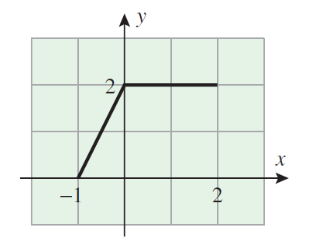
Нажмите, чтобы увидеть решение
- (a) \(y = f(x) - 1\): This is a vertical shift down by 1 unit. Every point on the original graph moves down by 1. The “corner” at \((-1,0)\) moves to \((-1,-1)\), the point at \((0,2)\) moves to \((0,1)\), and the segment from \((0,2)\) to \((2,2)\) moves to a segment from \((0,1)\) to \((2,1)\).
- (b) \(y = f(x - 1)\): This is a horizontal shift right by 1 unit. Every point on the original graph moves right by 1. The corner at \((-1,0)\) moves to \((0,0)\), the point at \((0,2)\) moves to \((1,2)\), and the segment from \((0,2)\) to \((2,2)\) moves to a segment from \((1,2)\) to \((3,2)\).
- (c) \(y = \frac{1}{2}f(x)\): This is a vertical compression by a factor of 2. The y-coordinate of every point is halved. The corner at \((-1,0)\) stays at \((-1,0)\). The point at \((0,2)\) moves to \((0,1)\), and the segment from \((0,2)\) to \((2,2)\) moves to a segment from \((0,1)\) to \((2,1)\).
- (d) \(y = f(-\frac{1}{2}x)\): This is a combination of two transformations:
- A reflection across the y-axis (due to the negative sign).
- A horizontal stretch by a factor of 2 (due to the \(1/2\)).
- The point \((-1,0)\) is first reflected to \((1,0)\), then stretched to \((2,0)\). The point \((0,2)\) stays at \((0,2)\). The point \((2,2)\) is first reflected to \((-2,2)\), then stretched to \((-4,2)\).
4.23. Доказательство по индукции (Глава 1, Пример 1)
По индукции докажите для всех \(n \in \mathbb{N}\): \[ \frac{1}{2} + \frac{1}{2^2} + \dots + \frac{1}{2^n} = 1 - \frac{1}{2^n} \]
Нажмите, чтобы увидеть решение
Let \(P(n)\) be the statement \(\sum_{i=1}^{n} \frac{1}{2^i} = 1 - \frac{1}{2^n}\).
- Base Step: We test the formula for \(n=1\).
- LHS = \(\frac{1}{2^1} = \frac{1}{2}\).
- RHS = \(1 - \frac{1}{2^1} = 1 - \frac{1}{2} = \frac{1}{2}\).
- Since LHS = RHS, \(P(1)\) is true.
- Inductive Step: Assume \(P(k)\) is true for some integer \(k \ge 1\). We must prove that \(P(k+1)\) is true.
- Assumption (Inductive Hypothesis): \(\frac{1}{2} + \frac{1}{2^2} + \dots + \frac{1}{2^k} = 1 - \frac{1}{2^k}\).
- Goal: We need to prove that \(\frac{1}{2} + \frac{1}{2^2} + \dots + \frac{1}{2^k} + \frac{1}{2^{k+1}} = 1 - \frac{1}{2^{k+1}}\).
- Proof: Start with the left side of the goal equation.
- LHS = \((\frac{1}{2} + \frac{1}{2^2} + \dots + \frac{1}{2^k}) + \frac{1}{2^{k+1}}\)
- Using the inductive hypothesis, substitute the sum in the parenthesis:
- \(= (1 - \frac{1}{2^k}) + \frac{1}{2^{k+1}}\)
- \(= 1 - \frac{2}{2 \cdot 2^k} + \frac{1}{2^{k+1}} = 1 - \frac{2}{2^{k+1}} + \frac{1}{2^{k+1}}\)
- \(= 1 - \frac{1}{2^{k+1}}\)
- This is equal to the right-hand side of the goal. Thus, \(P(k+1)\) is true.
- Conclusion: By the principle of mathematical induction, the formula is true for all natural numbers \(n\).
4.24. Иррациональность \(\sqrt{2}\) (Глава 1, Пример 2)
Докажите, что \(\sqrt{2}\) иррационально.
Нажмите, чтобы увидеть решение
- Assume the opposite (Proof by Contradiction): Assume that \(\sqrt{2}\) is a rational number. This means it can be written as a fraction \(\frac{p}{q}\) in lowest terms, where \(p\) and \(q\) are integers and their greatest common divisor is 1 (i.e., \(\text{gcd}(p, q) = 1\)).
- \(\sqrt{2} = \frac{p}{q}\)
- Manipulate the equation: Square both sides of the equation.
- \(2 = \frac{p^2}{q^2} \implies p^2 = 2q^2\).
- Deduce properties of \(p\): The equation \(p^2 = 2q^2\) shows that \(p^2\) is an even number. If a square of a number is even, the number itself must be even. Therefore, \(p\) is even.
- Express \(p\) as an even number: We can write \(p = 2k\) for some integer \(k\).
- Substitute and deduce properties of \(q\): Substitute \(p=2k\) back into the equation from step 2.
- \((2k)^2 = 2q^2 \implies 4k^2 = 2q^2 \implies q^2 = 2k^2\).
- This shows that \(q^2\) is also an even number, which means that \(q\) must also be even.
- Find the Contradiction: We have concluded that both \(p\) and \(q\) are even. If both are even, they share a common factor of 2. This contradicts our initial assumption that the fraction \(\frac{p}{q}\) was in its lowest terms (i.e., \(\text{gcd}(p, q) = 1\)).
- Conclusion: Since our initial assumption leads to a contradiction, the assumption must be false.
4.25. Доказательство по индукции (Глава 1, Пример 3)
По индукции докажите для всех \(n \in \mathbb{N}\): \[ \frac{1}{2} \cdot 2! + \frac{2}{2^2} \cdot 3! + \dots + \frac{n}{2^n}(n+1)! = \frac{(n+2)!}{2^n} - 2 \]
Нажмите, чтобы увидеть решение
Let \(P(n)\) be the given equation.
- Base Step: We test the formula for \(n=1\).
- LHS = \(\frac{1}{2^1}(1+1)! = \frac{1}{2} \cdot 2! = 1\).
- RHS = \(\frac{(1+2)!}{2^1} - 2 = \frac{3!}{2} - 2 = \frac{6}{2} - 2 = 3 - 2 = 1\).
- Since LHS = RHS, \(P(1)\) is true.
- Inductive Step: Assume \(P(k)\) is true for some integer \(k \ge 1\). We must prove \(P(k+1)\).
- Assumption (Inductive Hypothesis): \(\sum_{i=1}^{k} \frac{i}{2^i}(i+1)! = \frac{(k+2)!}{2^k} - 2\).
- Goal: Prove \(\sum_{i=1}^{k+1} \frac{i}{2^i}(i+1)! = \frac{(k+3)!}{2^{k+1}} - 2\).
- Proof:
- LHS of goal = \((\sum_{i=1}^{k} \frac{i}{2^i}(i+1)!) + \frac{k+1}{2^{k+1}}(k+2)!\).
- Using the inductive hypothesis:
- \(= (\frac{(k+2)!}{2^k} - 2) + \frac{k+1}{2^{k+1}}(k+2)!\)
- \(= (k+2)! \left( \frac{1}{2^k} + \frac{k+1}{2^{k+1}} \right) - 2\)
- \(= (k+2)! \left( \frac{2}{2^{k+1}} + \frac{k+1}{2^{k+1}} \right) - 2\)
- \(= (k+2)! \left( \frac{2 + k+1}{2^{k+1}} \right) - 2 = (k+2)! \frac{k+3}{2^{k+1}} - 2\)
- \(= \frac{(k+3)!}{2^{k+1}} - 2\).
- This is the RHS of the goal. Thus \(P(k+1)\) is true.
- Conclusion: By the principle of mathematical induction, the formula is true for all \(n \in \mathbb{N}\).
4.26. Иррациональность \(\sqrt{15}\) (Глава 1, Пример 4)
Докажите, что \(\sqrt{15}\) иррационально.
Нажмите, чтобы увидеть решение
- Assume the opposite (Proof by Contradiction): Assume that \(\sqrt{15}\) is rational. This means it can be expressed as a fraction \(\frac{p}{q}\) in lowest terms, where \(p, q\) are integers with \(\text{gcd}(p, q) = 1\).
- \(\sqrt{15} = \frac{p}{q}\)
- Manipulate the equation: Square both sides.
- \(15 = \frac{p^2}{q^2} \implies p^2 = 15q^2\).
- Deduce properties of \(p\): The equation \(p^2 = 15q^2\) shows that \(p^2\) is divisible by 3. Since 3 is a prime number, if it divides \(p^2\), it must also divide \(p\). Therefore, \(p\) is a multiple of 3.
- Express \(p\) as a multiple of 3: We can write \(p = 3k\) for some integer \(k\).
- Substitute and deduce properties of \(q\): Substitute \(p=3k\) back into the equation from step 2.
- \((3k)^2 = 15q^2 \implies 9k^2 = 15q^2 \implies 3k^2 = 5q^2\).
- This equation shows that \(5q^2\) is divisible by 3. Since 3 and 5 are prime, 3 must divide \(q^2\). Since 3 is prime, it must also divide \(q\). Therefore, \(q\) is also a multiple of 3.
- Find the Contradiction: We have shown that both \(p\) and \(q\) are multiples of 3. This means they share a common factor of 3, which contradicts our initial assumption that \(\frac{p}{q}\) was in lowest terms.
- Conclusion: The assumption that \(\sqrt{15}\) is rational leads to a contradiction, so it must be false.
4.27. Доказательство по индукции (Глава 1, Пример 5)
По индукции докажите \(n! > 3^n\) для всех целых \(n \ge 7\).
Нажмите, чтобы увидеть решение
Let \(P(n)\) be the statement \(n! > 3^n\).
- Base Step: The statement is for \(n \ge 7\), so our base case is \(n=7\).
- For \(n=7\), we have \(7! = 5040\).
- And \(3^7 = 2187\).
- Since \(5040 > 2187\), the statement \(P(7)\) is true.
- Inductive Step: Assume that \(P(k)\) is true for some arbitrary integer \(k \ge 7\). We must show that \(P(k+1)\) is true.
- Assumption (Inductive Hypothesis): \(k! > 3^k\) for some \(k \ge 7\).
- Goal: We need to prove that \((k+1)! > 3^{k+1}\).
- Proof:
- Start with the left side of the goal: \((k+1)! = (k+1) \cdot k!\).
- From our assumption, we know \(k! > 3^k\). We can substitute this to get an inequality:
- \((k+1)! > (k+1) \cdot 3^k\).
- Now we need to show that this is greater than \(3^{k+1}\). We need to show that \((k+1) \cdot 3^k > 3^{k+1}\).
- Dividing both sides by \(3^k\), this is equivalent to showing that \(k+1 > 3\).
- Since our assumption is for \(k \ge 7\), it is certainly true that \(k+1 > 3\).
- Therefore, \((k+1)! > (k+1) \cdot 3^k > 3 \cdot 3^k = 3^{k+1}\). This proves \(P(k+1)\) is true.
- Conclusion: By the principle of mathematical induction, the inequality is true for all integers \(n \ge 7\).
4.28. \(\min\), \(\inf\), \(\max\), \(\sup\) множеств (Глава 1, Пример 6)
Для указанных множеств найдите \(\min\), \(\inf\), \(\max\), \(\sup\), если они существуют.
- \(E = [-1, 2]\)
- \(E = [0, 1)\)
- \(E = \{1, \frac{1}{2}, \frac{1}{3}, \dots\}\)
- \(E = (1, \infty)\)
Нажмите, чтобы увидеть решение
- For \(E = [-1, 2]\) (a closed interval):
- The smallest element is -1, so \(\min(E) = -1\).
- The infimum (greatest lower bound) is equal to the minimum, so \(\inf(E) = -1\).
- The largest element is 2, so \(\max(E) = 2\).
- The supremum (least upper bound) is equal to the maximum, so \(\sup(E) = 2\).
- For \(E = [0, 1)\) (a half-open interval):
- The smallest element is 0, so \(\min(E) = 0\) and \(\inf(E) = 0\).
- The set gets arbitrarily close to 1 but never reaches it. There is no largest element, so \(\max(E)\) does not exist.
- The least upper bound is 1, so \(\sup(E) = 1\).
- For \(E = \{1, \frac{1}{2}, \frac{1}{3}, \dots\}\) (a sequence):
- The largest element is 1, so \(\max(E) = 1\) and \(\sup(E) = 1\).
- The set gets arbitrarily close to 0 but never reaches it. There is no smallest element, so \(\min(E)\) does not exist.
- The greatest lower bound is 0, so \(\inf(E) = 0\).
- For \(E = (1, \infty)\) (an open, unbounded interval):
- The set is not bounded above, so it has no maximum or supremum.
- The set gets arbitrarily close to 1 but never reaches it. There is no smallest element, so \(\min(E)\) does not exist.
- The greatest lower bound is 1, so \(\inf(E) = 1\).
4.29. Доказательство по индукции (Глава 1, Пример 7)
По индукции докажите, что \(4^n - 1\) делится на \(3\) при любом целом \(n \ge 1\).
Нажмите, чтобы увидеть решение
Let \(P(n)\) be the statement that \(4^n - 1\) is divisible by 3.
- Base Step: We must show that the statement is true for the initial value, \(n=1\).
- For \(n=1\), we have \(4^1 - 1 = 3\).
- Since 3 is divisible by 3, the statement \(P(1)\) is true.
- Inductive Step: We assume that the statement \(P(k)\) is true for some arbitrary integer \(k \ge 1\), and then we must show that \(P(k+1)\) is also true.
- Assumption (Inductive Hypothesis): Assume \(4^k - 1\) is divisible by 3. This means we can write \(4^k - 1 = 3m\) for some integer \(m\). This implies \(4^k = 3m + 1\).
- Goal: We need to prove that \(4^{k+1} - 1\) is divisible by 3.
- Proof:
- \(4^{k+1} - 1 = 4 \cdot 4^k - 1\)
- Substitute the expression for \(4^k\) from our assumption: \(4(3m + 1) - 1\)
- \(= 12m + 4 - 1\)
- \(= 12m + 3 = 3(4m + 1)\)
- Since \(4^{k+1} - 1\) can be written as 3 times an integer (\(4m+1\)), it is divisible by 3. Thus, \(P(k+1)\) is true.
- Conclusion: Since both the base step and the inductive step have been proven, by the principle of mathematical induction, the statement is true for all integers \(n \ge 1\).
4.30. Неравенство Бернулли (Глава 1, Пример 8)
По индукции докажите неравенство Бернулли: \((1+x)^n \ge 1+nx\) при \(n \ge 1\), \(x \ge 0\).
Нажмите, чтобы увидеть решение
Let \(P(n)\) be the statement \((1+x)^n \ge 1+nx\).
- Base Step: For \(n=1\).
- LHS = \((1+x)^1 = 1+x\).
- RHS = \(1 + 1 \cdot x = 1+x\).
- Since \(1+x \ge 1+x\), the statement \(P(1)\) is true.
- Inductive Step: Assume \(P(k)\) is true for some integer \(k \ge 1\). We must prove \(P(k+1)\).
- Assumption (Inductive Hypothesis): \((1+x)^k \ge 1+kx\).
- Goal: Prove \((1+x)^{k+1} \ge 1+(k+1)x\).
- Proof:
- Start with the LHS of the goal: \((1+x)^{k+1} = (1+x)^k (1+x)\).
- Since \(x \ge 0\), the term \((1+x)\) is non-negative. We can multiply both sides of the inductive hypothesis by \((1+x)\) without changing the inequality direction.
- \((1+x)^k (1+x) \ge (1+kx)(1+x)\).
- Expand the right side: \((1+kx)(1+x) = 1 + x + kx + kx^2 = 1 + (k+1)x + kx^2\).
- Since \(k \ge 1\) and \(x \ge 0\), the term \(kx^2\) must be non-negative (\(kx^2 \ge 0\)).
- Therefore, \(1 + (k+1)x + kx^2 \ge 1 + (k+1)x\).
- Combining our inequalities, we have \((1+x)^{k+1} \ge (1+kx)(1+x) \ge 1+(k+1)x\). This proves the goal.
- Conclusion: By the principle of mathematical induction, the inequality is true for all \(n \ge 1\) and \(x \ge 0\).
4.31. Доказательство по индукции (Глава 1, Пример 9)
По индукции докажите: \(\frac{1 \cdot 3 \cdots (2n-1)}{2 \cdot 4 \cdots 2n} < \frac{1}{\sqrt{2n+1}}\) при всех \(n \ge 1\).
Нажмите, чтобы увидеть решение
Let \(P(n)\) be the given inequality.
- Base Step: For \(n=1\).
- LHS = \(\frac{1}{2}\).
- RHS = \(\frac{1}{\sqrt{2(1)+1}} = \frac{1}{\sqrt{3}}\).
- The inequality is \(\frac{1}{2} < \frac{1}{\sqrt{3}}\). Squaring both sides gives \(\frac{1}{4} < \frac{1}{3}\), which is true. So \(P(1)\) is true.
- Inductive Step: Assume \(P(k)\) is true for some integer \(k \ge 1\). We must prove \(P(k+1)\).
- Assumption (Inductive Hypothesis): \(\frac{1 \cdot 3 \cdots (2k-1)}{2 \cdot 4 \cdots 2k} < \frac{1}{\sqrt{2k+1}}\).
- Goal: Prove \(\frac{1 \cdot 3 \cdots (2k-1) \cdot (2k+1)}{2 \cdot 4 \cdots 2k \cdot (2k+2)} < \frac{1}{\sqrt{2k+3}}\).
- Proof:
- Start with the LHS of the goal: LHS = \(\left(\frac{1 \cdot 3 \cdots (2k-1)}{2 \cdot 4 \cdots 2k}\right) \cdot \frac{2k+1}{2k+2}\).
- Using the inductive hypothesis, we can write: LHS \(< \frac{1}{\sqrt{2k+1}} \cdot \frac{2k+1}{2k+2} = \frac{\sqrt{2k+1}}{2k+2}\).
- Now we just need to prove that \(\frac{\sqrt{2k+1}}{2k+2} < \frac{1}{\sqrt{2k+3}}\).
- Since both sides are positive, we can square them: \(\frac{2k+1}{(2k+2)^2} < \frac{1}{2k+3}\).
- Cross-multiply: \((2k+1)(2k+3) < (2k+2)^2\).
- \(4k^2 + 8k + 3 < 4k^2 + 8k + 4\).
- This simplifies to \(3 < 4\), which is always true.
- Since all steps are valid, we have proven that \(P(k+1)\) is true.
- Conclusion: By the principle of mathematical induction, the inequality holds for all \(n \ge 1\).
4.32. Иррациональность суммы корней (Глава 1, Пример 10)
Докажите, что \(\sqrt{3} + \sqrt{5}\) иррационально.
Нажмите, чтобы увидеть решение
- Assume the opposite (Proof by Contradiction): Assume that \(r = \sqrt{3} + \sqrt{5}\) is a rational number.
- Manipulate the Equation: Square both sides of the equation.
- \(r^2 = (\sqrt{3} + \sqrt{5})^2 = (\sqrt{3})^2 + 2\sqrt{3}\sqrt{5} + (\sqrt{5})^2 = 3 + 2\sqrt{15} + 5 = 8 + 2\sqrt{15}\).
- Isolate the Radical: Rearrange the equation to solve for \(\sqrt{15}\).
- \(r^2 - 8 = 2\sqrt{15} \implies \sqrt{15} = \frac{r^2 - 8}{2}\).
- Find the Contradiction:
- From our initial assumption, \(r\) is rational. The square of a rational number is rational, and the difference and quotient of rational numbers are also rational. Therefore, the right-hand side, \(\frac{r^2-8}{2}\), must be a rational number.
- However, the left-hand side, \(\sqrt{15}\), is known to be an irrational number.
- This leads to the statement that a rational number is equal to an irrational number, which is a contradiction.
- Conclusion: The initial assumption that \(\sqrt{3} + \sqrt{5}\) is rational must be false.
4.33. Неравенство треугольника (Глава 1, Пример 11)
Докажите неравенство треугольника: для любых \(x,y\in\mathbb{R}\) выполнено \(|x+y| \le |x| + |y|\).
Нажмите, чтобы увидеть решение
- Use the property of absolute values: For any real number \(z\), we know that \(z \le |z|\) and \(-z \le |z|\).
- Therefore, we have \(x \le |x|\) and \(y \le |y|\).
- We also have \(-x \le |x|\) and \(-y \le |y|\).
- Combine the inequalities:
- Adding the first pair of inequalities gives: \(x + y \le |x| + |y|\).
- Adding the second pair of inequalities gives: \(-x - y \le |x| + |y|\), which can be written as \(-(x+y) \le |x| + |y|\).
- Apply the equivalence from the previous problem: We have shown that both \((x+y) \le |x|+|y|\) and \(-(x+y) \le |x|+|y|\) are true.
- This is equivalent to the statement \(|x+y| \le |x|+|y|\).
4.34. Эквивалентность с модулем (Глава 1, Пример 12)
Докажите, что для любых \(x,y\in\mathbb{R}\) неравенство \(|x| \le y\) эквивалентно \(-y \le x \le y\).
Нажмите, чтобы увидеть решение
- Prove the forward direction (\(\Rightarrow\)): Assume \(|x| \le y\).
- Case 1: \(x \ge 0\). In this case, \(|x| = x\). The assumption becomes \(x \le y\). Since \(x \ge 0\), it must be that \(y \ge 0\). From \(y \ge 0\), we get \(-y \le 0\). Combining these gives \(-y \le 0 \le x \le y\), which implies \(-y \le x \le y\).
- Case 2: \(x < 0\). In this case, \(|x| = -x\). The assumption becomes \(-x \le y\). Multiplying by -1 reverses the inequality, giving \(x \ge -y\). Since \(x < 0\), it follows that \(y \ge 0\). Combining these gives \(-y \le x < 0 \le y\), which implies \(-y \le x \le y\).
- In both cases, we have shown that if \(|x| \le y\), then \(-y \le x \le y\).
- Prove the backward direction (\(\Leftarrow\)): Assume \(-y \le x \le y\).
- Case 1: \(x \ge 0\). The right side of the assumption is \(x \le y\). Since \(x \ge 0\), \(|x| = x\), so we have \(|x| \le y\).
- Case 2: \(x < 0\). The left side of the assumption is \(-y \le x\). Multiplying by -1 gives \(y \ge -x\). Since \(x < 0\), \(|x| = -x\), so we have \(y \ge |x|\), which is equivalent to \(|x| \le y\).
- In both cases, we have shown that if \(-y \le x \le y\), then \(|x| \le y\).
4.35. Эквивалентность аксиом полноты (Глава 1, Пример 13)
Докажите эквивалентность двух формулировок полноты для \(\mathbb{R}\):
- (A16) For any two nonempty sets M and N of real numbers such that \(x \le y\) for all \(x \in M\) and \(y \in N\), there exists a real number \(c\) such that \(x \le c \le y\) for all \(x \in M\) and \(y \in N\).
- (A16’) Every nonempty set of real numbers that is bounded above has a unique least upper bound (supremum).
Нажмите, чтобы увидеть решение
- Prove (A16) \(\Rightarrow\) (A16’):
- Assume (A16) is true. Let \(M\) be a nonempty set of real numbers that is bounded above. We need to show it has a unique least upper bound.
- Define a new set \(N = \{y \in \mathbb{R} \ | \ y \ge x, \forall x \in M \}\). This is the set of all upper bounds for \(M\). Since \(M\) is bounded above, \(N\) is not empty.
- By the definition of the sets \(M\) and \(N\), we have \(x \le y\) for all \(x \in M\) and \(y \in N\).
- According to axiom (A16), there must exist a number \(c\) such that \(x \le c \le y\) for all \(x \in M\) and \(y \in N\).
- The condition \(x \le c\) means \(c\) is an upper bound for \(M\). The condition \(c \le y\) means \(c\) is less than or equal to every other upper bound.
- Therefore, \(c\) is the least upper bound (supremum) of \(M\). Uniqueness can be proven by assuming two least upper bounds \(b_1, b_2\), which leads to \(b_1 \le b_2\) and \(b_2 \le b_1\), implying \(b_1=b_2\).
- Prove (A16’) \(\Rightarrow\) (A16):
- Assume (A16’) is true. Let \(M\) and \(N\) be two nonempty sets such that \(x \le y\) for all \(x \in M\) and \(y \in N\).
- From this condition, any element of \(N\) is an upper bound for the set \(M\). Since \(N\) is nonempty, this means \(M\) is bounded above.
- According to axiom (A16’), the set \(M\) must have a unique least upper bound, let’s call it \(c = \sup(M)\).
- By definition of supremum, \(x \le c\) for all \(x \in M\).
- We also need to show \(c \le y\) for all \(y \in N\). Assume for contradiction that there is some \(y_0 \in N\) such that \(y_0 < c\). Since \(y_0\) is an upper bound for \(M\) (by definition of N), this would mean \(y_0\) is an upper bound smaller than the least upper bound \(c\), which is a contradiction.
- Therefore, \(c \le y\) for all \(y \in N\). We have found a number \(c\) such that \(x \le c \le y\) for all \(x \in M, y \in N\), which proves (A16).
4.36. \(\mathbb{N}\) не ограничено сверху (Глава 1, Пример 14)
Докажите, что \(\mathbb{N} = \{1, 2, 3, \dots\}\) не ограничено сверху в \(\mathbb{R}\).
Нажмите, чтобы увидеть решение
- Assume the opposite (Proof by Contradiction): Assume that \(\mathbb{N}\) is bounded above.
- Apply the Completeness Axiom: Since \(\mathbb{N}\) is a nonempty set of real numbers that is bounded above, by the completeness axiom (A16’), it must have a least upper bound (supremum). Let’s call this least upper bound \(b\).
- Use the Definition of Supremum: The number \(b\) is an upper bound, so for every natural number \(n\), we have \(n \le b\).
- Consider the Successor: If \(m\) is a natural number, then \(m+1\) is also a natural number. Therefore, according to our assumption, \(m+1 \le b\).
- Derive a New Upper Bound: If we subtract 1 from both sides of the inequality \(m+1 \le b\), we get \(m \le b-1\). This must be true for all natural numbers \(m\).
- Find the Contradiction: The statement “\(m \le b-1\) for all \(m \in \mathbb{N}\)” means that \(b-1\) is also an upper bound for the set \(\mathbb{N}\). However, \(b-1 < b\). This contradicts our initial statement that \(b\) was the least upper bound.
- Conclusion: The initial assumption that \(\mathbb{N}\) is bounded above must be false.
4.37. Плотность \(\mathbb{Q}\) (Глава 1, Пример 15)
Докажите: если \(x<y\), то существует \(r\in\mathbb{Q}\) с \(x<r<y\).
Нажмите, чтобы увидеть решение
- Use the Archimedean Property: Since \(x < y\), the difference \(y-x\) is a positive real number. By the Archimedean Property (which follows from the unboundedness of \(\mathbb{N}\)), there exists a natural number \(n\) such that \(n(y-x) > 1\). This implies \(\frac{1}{n} < y-x\).
- Construct an Integer: Consider the number \(nx\). Let \(m\) be the greatest integer less than or equal to \(nx\). This is denoted \(m = \lfloor nx \rfloor\). By definition of the floor function, we have \(m \le nx < m+1\).
- Construct a Rational Number: Divide the inequality by \(n\): \(\frac{m}{n} \le x < \frac{m+1}{n}\). Let’s define the rational number \(r = \frac{m+1}{n}\).
- Show \(x < r\): From the inequality in the previous step, we directly have \(x < \frac{m+1}{n} = r\).
- Show \(r < y\): From step 2, we know \(m+1 > nx\). So \(r = \frac{m+1}{n} > \frac{nx}{n} = x\). We also know \(m \le nx\), which means \(m+1 \le nx+1\). Therefore, \(r = \frac{m+1}{n} \le \frac{nx+1}{n} = x + \frac{1}{n}\).
- From step 1, we established that \(\frac{1}{n} < y-x\).
- Combining these, we get \(r \le x + \frac{1}{n} < x + (y-x) = y\).
- Conclusion: We have shown that \(x < r\) and \(r < y\).
4.38. Плотность иррациональных (Глава 1, Пример 16)
Докажите: если \(x<y\), то существует иррациональное \(t\) с \(x<t<y\).
Нажмите, чтобы увидеть решение
- Case 1: Assume \(x\) and \(y\) are rational.
- Since \(x < y\), we have \(y-x > 0\). Consider the number \(t = x + \frac{y-x}{\sqrt{2}}\).
- Since \(\sqrt{2}\) is irrational and \(\frac{y-x}{2} \neq 0\), the term \(\frac{y-x}{\sqrt{2}}\) is irrational. The sum of a rational number (\(x\)) and an irrational number is irrational, so \(t\) is irrational.
- Since \(\sqrt{2} > 1\), we have \(0 < \frac{1}{\sqrt{2}} < 1\).
- Multiplying by the positive number \(y-x\), we get \(0 < \frac{y-x}{\sqrt{2}} < y-x\).
- Adding \(x\) to all parts of the inequality gives \(x < x + \frac{y-x}{\sqrt{2}} < x + (y-x)\), which simplifies to \(x < t < y\).
- Case 2: General case (x, y may be irrational).
- By the density of rational numbers (proven previously), since \(x < y\), we can find a rational number \(r_1\) such that \(x < r_1 < y\).
- Again, by the density of rational numbers, we can find another rational number \(r_2\) such that \(r_1 < r_2 < y\).
- Now we have two rational numbers \(r_1\) and \(r_2\) with \(x < r_1 < r_2 < y\).
- Applying the result from Case 1 to the rational numbers \(r_1\) and \(r_2\), there must exist an irrational number \(t\) such that \(r_1 < t < r_2\).
- By transitivity, we have \(x < r_1 < t < r_2 < y\), which implies \(x < t < y\).
4.39. Счётность объединений (Глава 1, Пример 17)
Докажите, что конечное или счётное объединение счётных множеств счётно.
Нажмите, чтобы увидеть решение
- Case 1: Union of two countable sets.
- Let \(A = \{a_1, a_2, a_3, \dots\}\) and \(B = \{b_1, b_2, b_3, \dots\}\) be two countable sets.
- We can create a list of all elements in the union \(A \cup B\) by alternating between the sets: \(a_1, b_1, a_2, b_2, a_3, b_3, \dots\).
- This process creates a single list (a sequence) that includes every element from both sets. To make it a formal enumeration, we can assign a new natural number to each element in the order it appears, skipping any element that has already been listed (if \(A \cap B\) is not empty).
- Since we can list all elements of \(A \cup B\) in a sequence, the union is countable. This can be extended to any finite number of sets.
- Case 2: Countable union of countable sets.
- Let the sets be \(A_1, A_2, A_3, \dots\), where each set \(A_k\) is itself countable: \(A_k = \{a_{k1}, a_{k2}, a_{k3}, \dots\}\).
- We can arrange all elements in a grid: \(a_{11}, a_{12}, a_{13}, \dots\) \(a_{21}, a_{22}, a_{23}, \dots\) \(a_{31}, a_{32}, a_{33}, \dots\) …
- We can list all these elements by traversing the grid diagonally (Cantor’s diagonal argument for pairing). We list elements with the same sum of indices: \(a_{11}\), then \(a_{12}, a_{21}\), then \(a_{13}, a_{22}, a_{31}\), and so on.
- This method creates a single sequence that will eventually include every element from every set in the union. Therefore, the countable union of countable sets is countable.
4.40. Счётность \(\mathbb{Q}\) (Глава 1, Пример 18)
Докажите, что \(\mathbb{Q}\) счётно.
Нажмите, чтобы увидеть решение
- Represent \(\mathbb{Q}\) as a Union: The set of all rational numbers can be represented as the union of many sets. For instance, consider the sets of fractions with a fixed denominator.
- Define Countable Sets: For each natural number \(k \in \mathbb{N}\), define the set \(A_k\) as the set of all fractions with denominator \(k\):
- \(A_k = \{\frac{n}{k} \ | \ n \in \mathbb{Z} = \{0, \pm 1, \pm 2, \dots\}\}\).
- Show Each Set is Countable: For any fixed \(k\), the set \(A_k\) is in a one-to-one correspondence with the set of integers \(\mathbb{Z}\) (the map \(f(n) = n/k\) is a bijection). Since the set of integers \(\mathbb{Z}\) is countable, each set \(A_k\) is countable.
- Apply the Union Theorem: The set of all rational numbers \(\mathbb{Q}\) is the union of all these sets: \(\mathbb{Q} = \bigcup_{k=1}^{\infty} A_k\).
- Conclusion: We have expressed \(\mathbb{Q}\) as a countable union of countable sets. Based on the previous theorem, such a union is itself a countable set.
4.41. Несчётность \([0,1]\) (Глава 1, Пример 19)
Докажите, что множество вещественных чисел на отрезке \([0,1]\) несчётно.
Нажмите, чтобы увидеть решение
- Assume the opposite (Proof by Contradiction): Assume that the set \([0,1]\) is countable. This means we can list all the real numbers in this interval in a sequence: \(x_1, x_2, x_3, \dots\).
- Represent Numbers by Decimals: Let’s write the decimal expansion for each number in the list. (To ensure uniqueness, we avoid expansions ending in infinite 9s).
- \(x_1 = 0.a_{11}a_{12}a_{13}\dots\)
- \(x_2 = 0.a_{21}a_{22}a_{23}\dots\)
- \(x_3 = 0.a_{31}a_{32}a_{33}\dots\)
- … where each digit \(a_{nk}\) is an integer from 0 to 9.
- Construct a New Number (Cantor’s Diagonal Argument): We will now construct a new real number, \(y\), which is in the interval \([0,1]\) but is not in our list. Let \(y = 0.b_1b_2b_3\dots\). We define each digit \(b_n\) of \(y\) based on the \(n\)-th digit of the \(n\)-th number in the list, \(a_{nn}\).
- We choose \(b_n\) to be different from \(a_{nn}\). A simple rule is:
- \(b_n = 1\) if \(a_{nn} \neq 1\).
- \(b_n = 2\) if \(a_{nn} = 1\).
- We choose \(b_n\) to be different from \(a_{nn}\). A simple rule is:
- Find the Contradiction:
- The number \(y\) that we constructed is a real number in the interval \([0,1]\).
- By its construction, \(y\) cannot be equal to any number \(x_n\) in our list. Why? Because for any \(n\), the \(n\)-th decimal digit of \(y\) (which is \(b_n\)) is different from the \(n\)-th decimal digit of \(x_n\) (which is \(a_{nn}\)).
- This means our list, which supposedly contained all real numbers in \([0,1]\), is missing at least one number, \(y\). This is a contradiction.
- Conclusion: The initial assumption that the set $$ is countable must be false.
4.42. Формулировка принципа индукции (Глава 1, Пример 20)
Сформулируйте принцип математической индукции и кратко опишите идею доказательства.
Нажмите, чтобы увидеть решение
- Statement of the Principle: Let \(P(n)\) be a statement that depends on a natural number \(n \in \mathbb{N}\). If the following two conditions are met:
- (1) Base Step: The statement \(P(1)\) is true.
- (2) Inductive Step: The implication “if \(P(k)\) is true, then \(P(k+1)\) is true” holds for any natural number \(k\).
- Then, the statement \(P(n)\) is true for all natural numbers \(n \in \mathbb{N}\).
- Proof Outline (by Contradiction):
- Assume the principle is false. This means that both conditions (1) and (2) are satisfied, yet there is at least one natural number \(n\) for which the statement \(P(n)\) is false.
- Let \(S\) be the set of all natural numbers for which \(P(n)\) is false: \(S = \{n \in \mathbb{N} \ | \ P(n) \text{ is false}\}\).
- By our assumption, the set \(S\) is not empty.
- By the well-ordering principle of natural numbers, every non-empty set of natural numbers has a least element. Let \(s_0\) be the least element of \(S\).
- Since \(P(1)\) is true (by condition 1), \(1\) is not in \(S\). Therefore, \(s_0 \neq 1\), which means \(s_0 \ge 2\).
- Since \(s_0\) is the least element for which P is false, the statement must be true for the number just before it, \(s_0 - 1\). So, \(P(s_0 - 1)\) is true.
- But now we can apply the inductive step (condition 2). Since \(P(s_0 - 1)\) is true, the implication tells us that \(P((s_0-1)+1) = P(s_0)\) must also be true.
- This is a contradiction, because we defined \(s_0\) as an element for which \(P(s_0)\) is false.
- Therefore, our initial assumption that the principle is false must be wrong.